
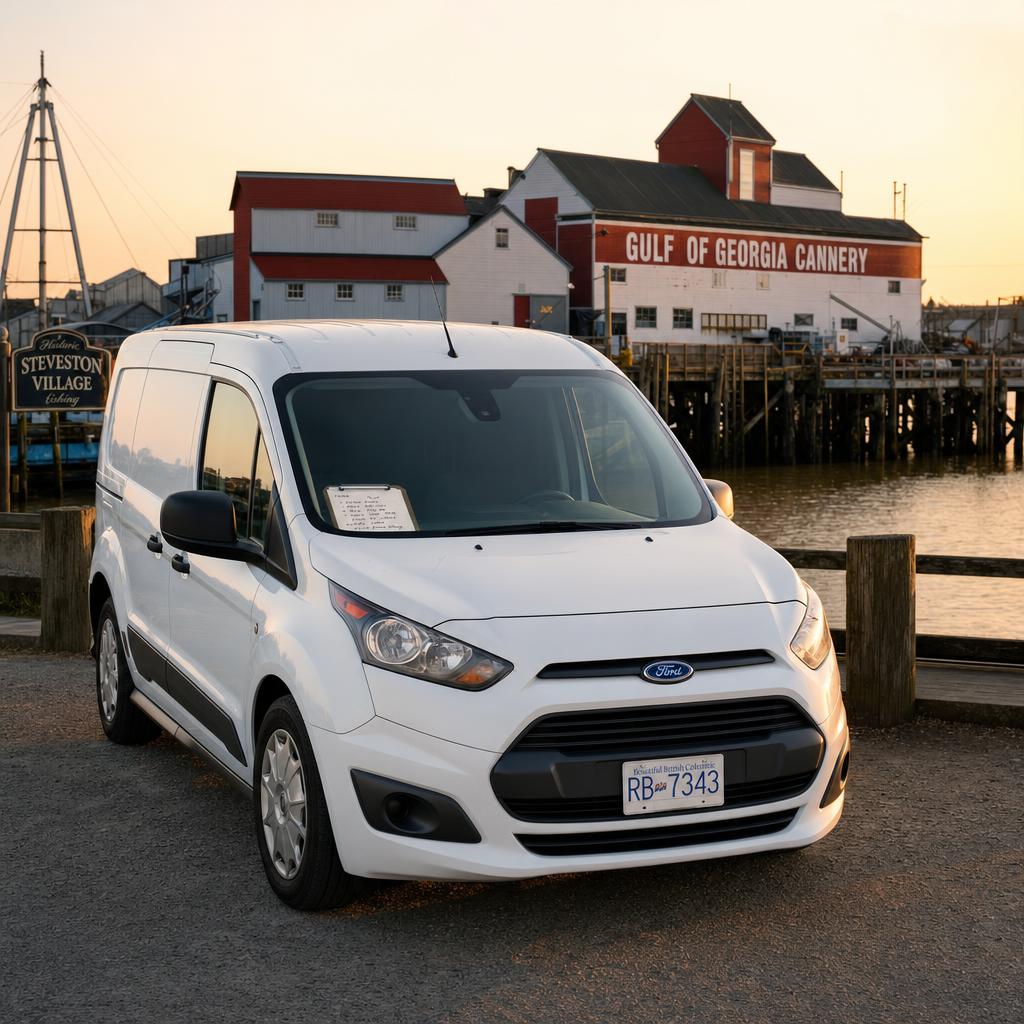
My grandfather worked on the boats. My father worked on the roofs. I work on the doors. Different trades, same problem: salt finds everything.
If your spring or cables failed in under seven years and you live near the water — English Bluff, Beach Grove, Marine Drive in White Rock, oceanfront West Van, the Steveston riverfront, anywhere in Ladner that smells like the Fraser at low tide — corrosion is the cause. Not the cycle count. Not the cold. Just chloride doing what chloride does to carbon steel.
What salt actually does to a spring
Garage door torsion springs are made of high-carbon steel. Galvanized springs get a thin zinc coating; oil-tempered springs get a baked-on oil residue and a black-oxide finish. Both work fine inland. Neither was designed for direct ocean air.
The salt arrives two ways. The first is salt mist — fine droplets of seawater that travel inland on the wind, dry on whatever surface they hit, and leave chloride behind. The second is high humidity, which holds chloride in solution against the metal for days at a time. The combination is more aggressive than either alone.
What happens at the molecular level: chloride ions break down the protective passivation layer on steel, then accelerate the oxidation reaction underneath. You get pitting — small rough patches that look like nothing — long before you see surface rust. Once pitting starts, the spring's fatigue life drops dramatically. A spring rated for 10,000 cycles in dry inland air might give you 6,000 or 7,000 in Tsawwassen.
The cables go first
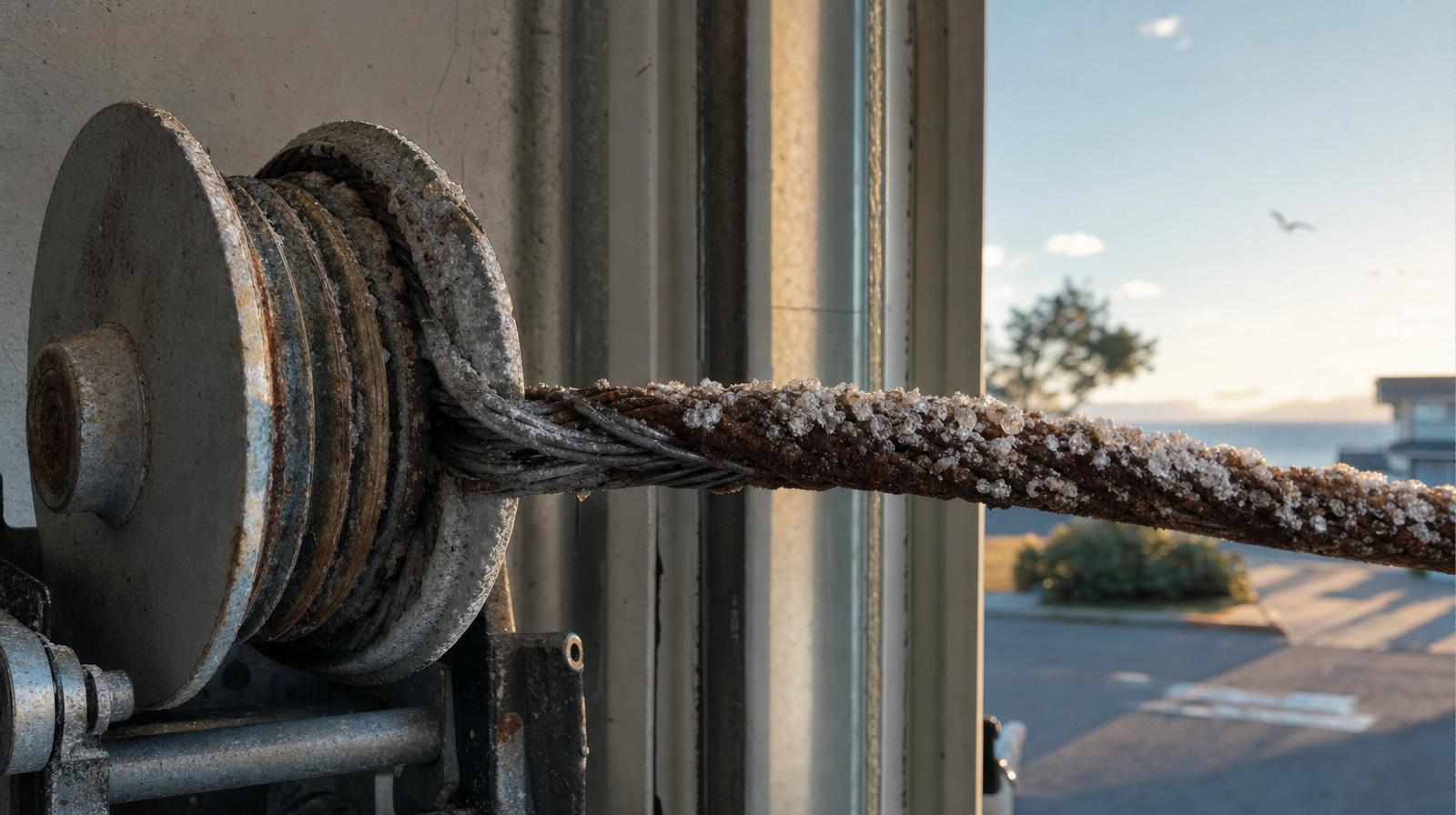
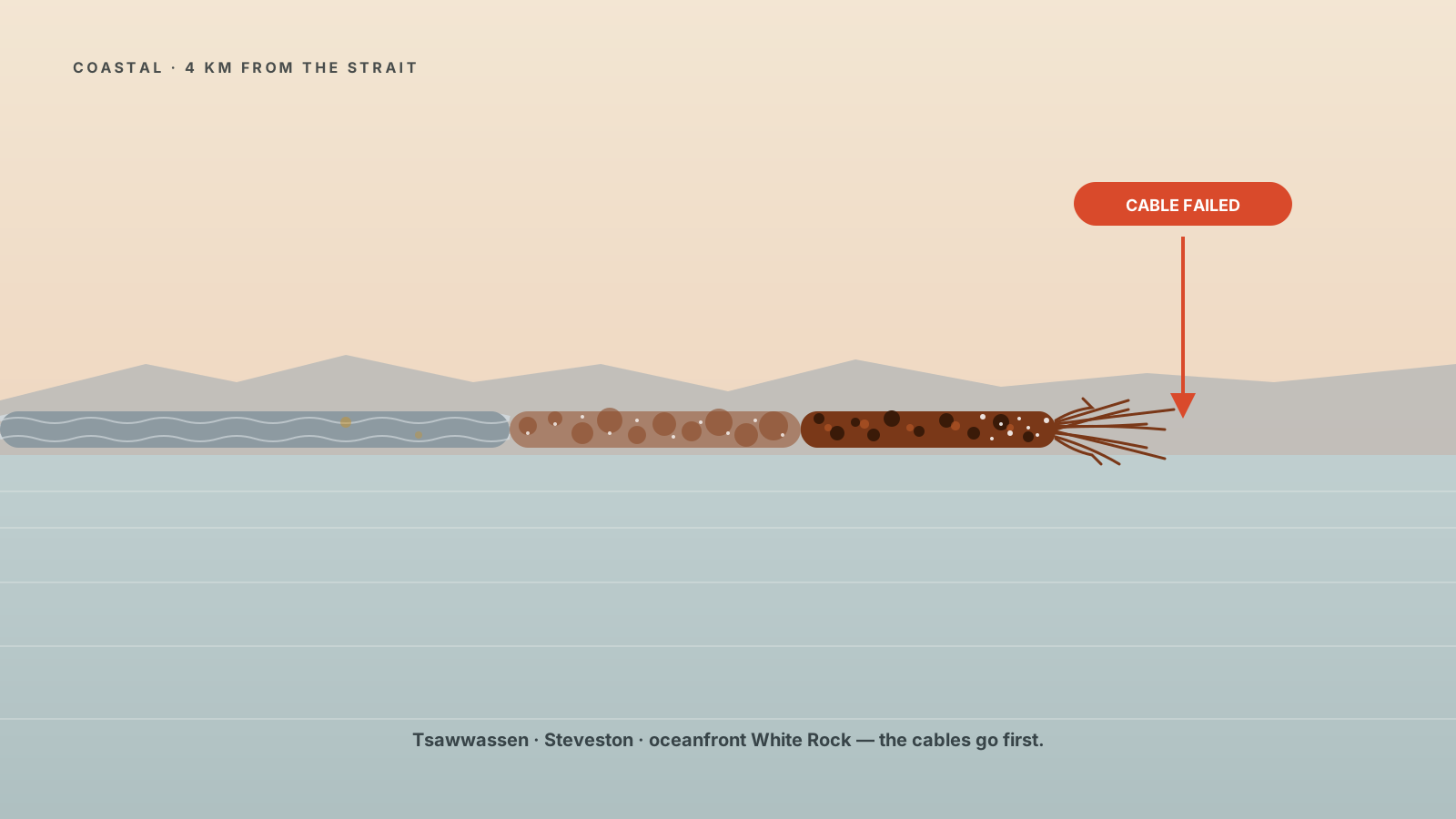
It's almost always the cables, not the springs themselves. Cables are bundled steel wire, much thinner per strand than a spring coil, with much more surface area exposed per kilogram. They fray from the inside out. By the time you can see the fraying on the outside, the cable has already lost most of its strength.
I've personally pulled cables out of Tsawwassen garages that were six years old and disintegrated when I touched them. Same homeowner had bought "premium" springs from a previous installer — galvanized, advertised as "rust-resistant." The springs were fine. The cables had let go three weeks earlier and the homeowner hadn't noticed until the door dropped.
That's a $2,300 panel-and-tracks repair. All because nobody thought about the cables.
What we use instead
On every coastal install, we run two changes from the standard package:
- Oil-tempered springs only. No galvanized. The oil-tempered finish is more corrosion-resistant in chloride environments and the steel grade is more fatigue-tolerant. The cost difference is small. The lifespan difference is substantial.
- Stainless steel cables for direct-water-view homes. Stainless costs roughly $40 more in parts than standard galvanized cables. In Tsawwassen English Bluff, oceanfront White Rock, and the Steveston dyke, stainless lasts roughly twice as long. That's the right trade.
For homes a few blocks inland — Tsawwassen Heights, central White Rock, most of Richmond — galvanized cables with the two-spring tier's free upgrade are usually fine. We make the call on site based on the prevailing wind and how close you are to open water.
What you can do between service calls
Hose the hardware down with fresh water
Salt is water-soluble. A quick fresh-water rinse on the hardware (springs, cables, tracks, rollers) once a month dissolves the chloride before it concentrates. Don't soak the opener. Don't blast the seal. Just a low-pressure rinse with the garden hose.
Use silicone spray, not WD-40
Silicone-based lubricant on the hinges, rollers, and bearings provides a moisture barrier. WD-40 is a degreaser, not a lubricant — it strips protective oils and leaves the metal more exposed. Don't use it.
Keep an eye on the cables
Open the door halfway, look at the cables on each side from a safe angle (don't reach into the spring area). Any visible fraying, rust spots, or one cable looking different from the other — call us. Cables fail predictably and noisily. If you can hear new noises when the door cycles, that's the first warning.
Cities where we run coastal spec by default
- Tsawwassen — English Bluff, Beach Grove, Pebble Hill
- Richmond — Steveston, Terra Nova, Seafair, Quilchena waterfront
- White Rock — East Beach, West Beach, Marine Drive
- Delta — Ladner Village, oceanfront properties
- West Vancouver — Marine Drive, Caulfeild, Eagle Harbour
Same flat-rate, smarter materials. Cables included free with the two-spring tier — stainless on parts upcharge for direct-oceanfront addresses.
Call (778) 800-0769One phone call. Same family. Same number. Same crew who's been replacing springs from Steveston to Ladner since before half of you moved to the peninsula.