
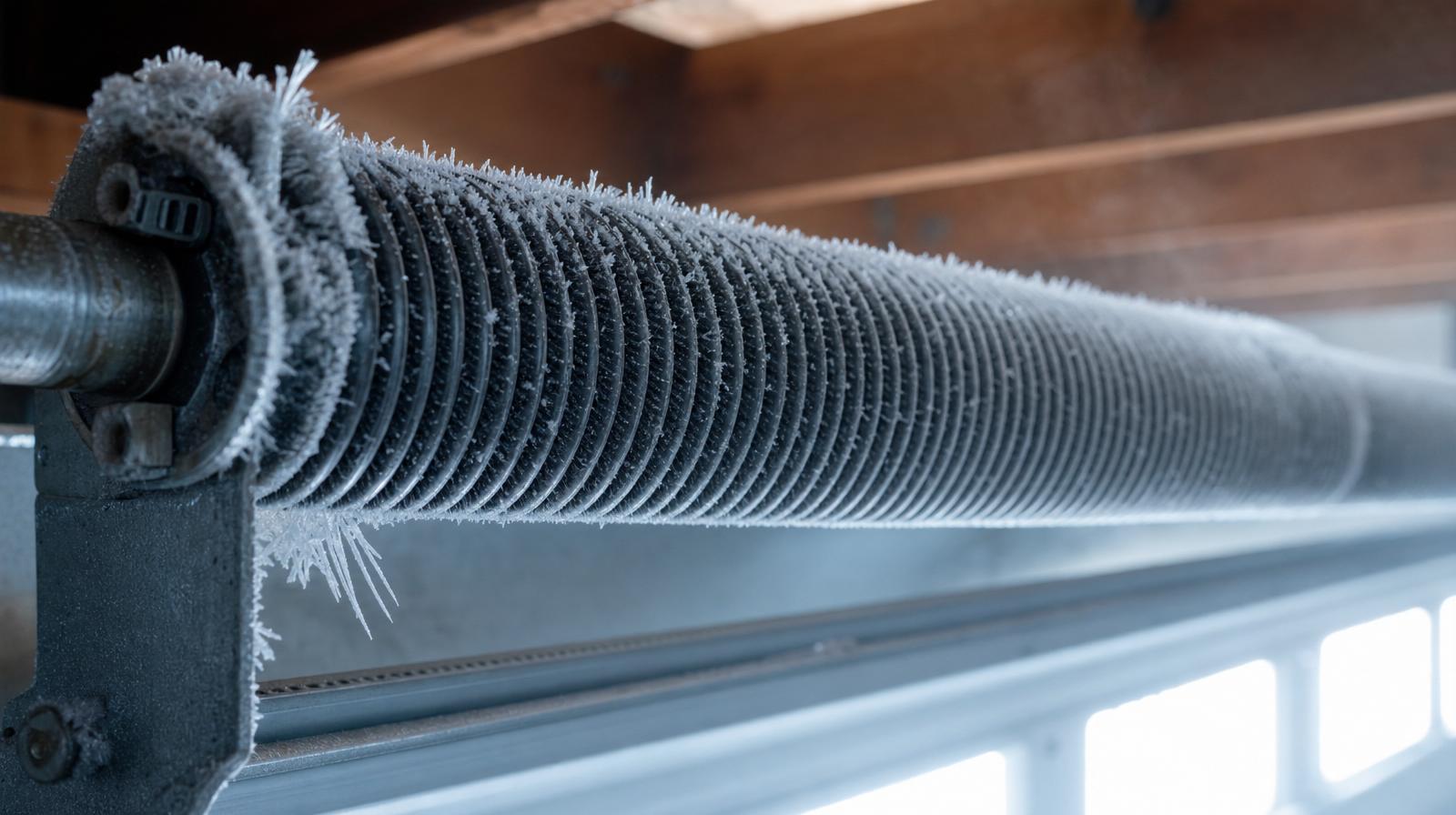
Garage door springs are made of oil-tempered high-carbon steel. That alloy is wonderful at storing energy through twisting (which is what springs do). It's less wonderful at handling cold.
The metallurgy in 4 paragraphs
Steel undergoes a thing called the ductile-to-brittle transition as temperature drops. Above the transition zone, the metal flexes and absorbs energy under sudden load — ductile behaviour. Below the transition zone, the metal cracks instead of flexing — brittle behaviour. For high-carbon spring steel, the transition zone starts somewhere around 0°C and gets dramatically worse below -10°C.
What that means in practice: a spring that handled 4 cycles a day for 8 years in mild weather can crack on the first cycle of a cold morning. The metal is the same. The load is the same. The temperature is different.
The crack is usually invisible. The spring runs through one full cycle, the crack propagates over a few minutes or hours, and the next cycle releases the stored energy. Bang.
This is why spring failure clusters around cold mornings — not because cold "uses up" springs in some folkloric way, but because brittle steel doesn't bend, it breaks.
What "cold snap" means in Vancouver
You don't need a polar vortex. The Lower Mainland's mild winters are deceptive — a single overnight dip to -3°C is enough to push a tired 9-year-old spring over the edge.
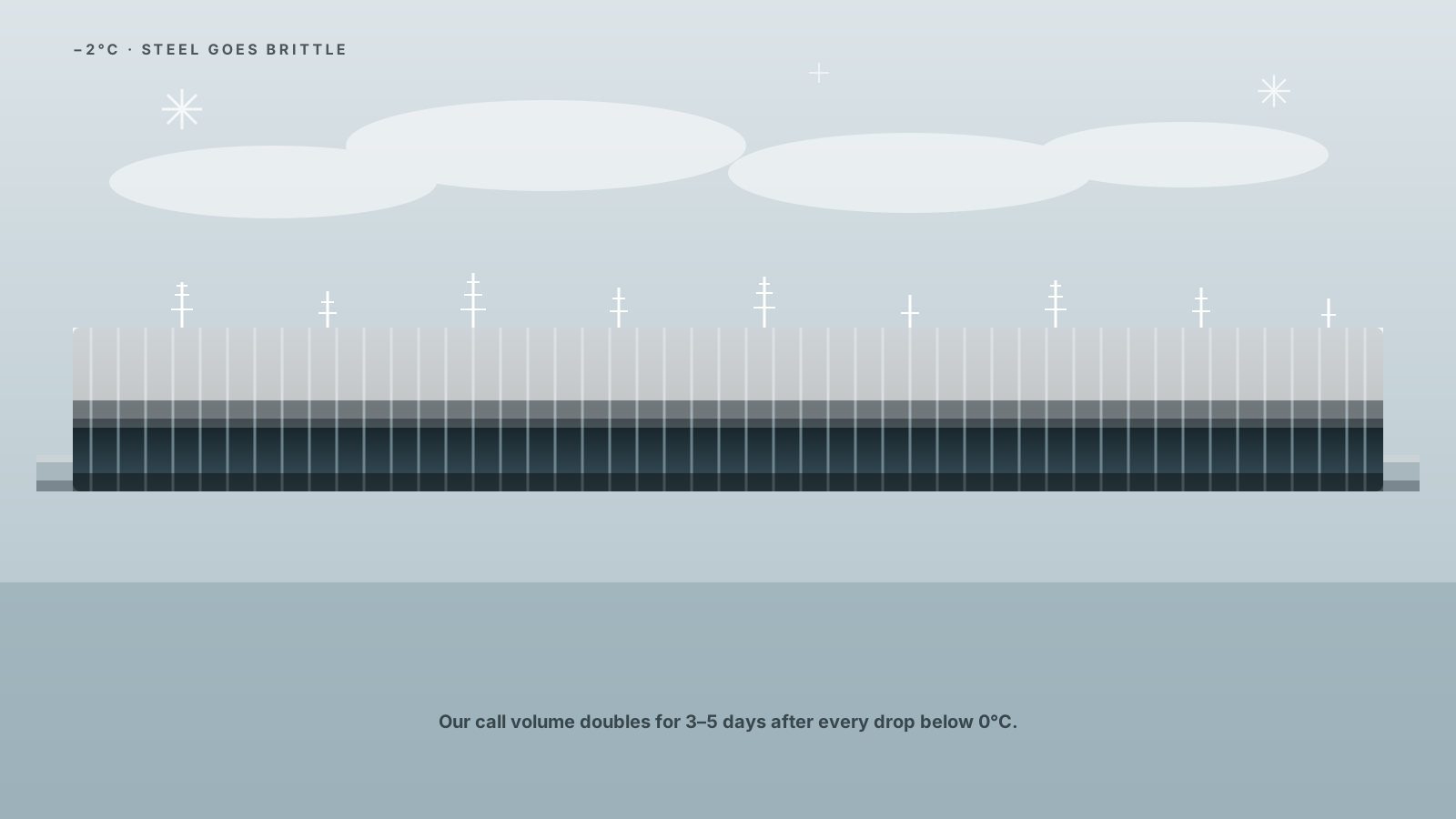
Our dispatch log shows our call volume roughly doubles for 3 to 5 days after every dip below 0°C. The 2025–26 winter was the first snowless one at YVR airport since 1982-83, and we still had a clear call-volume spike in mid-February when the only sustained cold dip hit (lows of -3 to -5°C). The pattern holds even in our mildest winter on record.
Who's most at risk
- Anyone with springs older than 7 years. Fatigue + cold = failure.
- Anyone at elevation. Burnaby Mountain, Westwood Plateau, Burke Mountain, Heritage Mountain, British Properties, North Shore foothills — these sit at 200–400 m, which gets noticeably colder than the flats.
- Galvanized springs. Cheaper than oil-tempered, more brittle when cold.
- People who hit the opener at the coldest moment of the day (6–8 a.m.). The spring is at minimum temperature; it's about to do its highest-stress cycle of the day. Worst possible timing.
What you can actually do about it
Short-term (right now)
On forecast cold mornings (below 0°C overnight), consider letting the garage warm up for an hour after sunrise before cycling. The 5–10°C swing makes a real difference at the margin.
Lubricate hinges, rollers, and bearings with white lithium grease before winter. Don't use WD-40 (it's a degreaser, not a lubricant). Don't grease the tracks (they should stay dry). Lube doesn't save a brittle spring, but it reduces stress on the whole system.
Long-term (next replacement)
Upgrade to high-cycle springs. 25,000-cycle springs have a different alloy formulation that holds ductility down to lower temperatures. Sealed bearings on the shaft also reduce friction in cold. The high-cycle upgrade is a modest premium over the standard two-spring tier. For mountain homes and elevation neighbourhoods, this isn't a luxury — it's the right spec.
The fatalistic option
Don't upgrade, accept that the spring will break on a cold morning sometime in the next 1–3 years, and have our number saved. That's not how this should work, but it's how most people do it.
"Won't the cold also break my opener motor?"
The opener gear can struggle in extreme cold, especially if the spring is already weakening (more load on the motor). But a healthy opener should handle Vancouver winters fine. If the opener strains AND the door is heavy in your hand when you manually lift it, that's the spring, not the motor. If the opener strains and the door is light, that's the motor.
Either way, call.
Same-day repair, flat-rate, no after-hours upcharge.
Call (778) 800-0769