
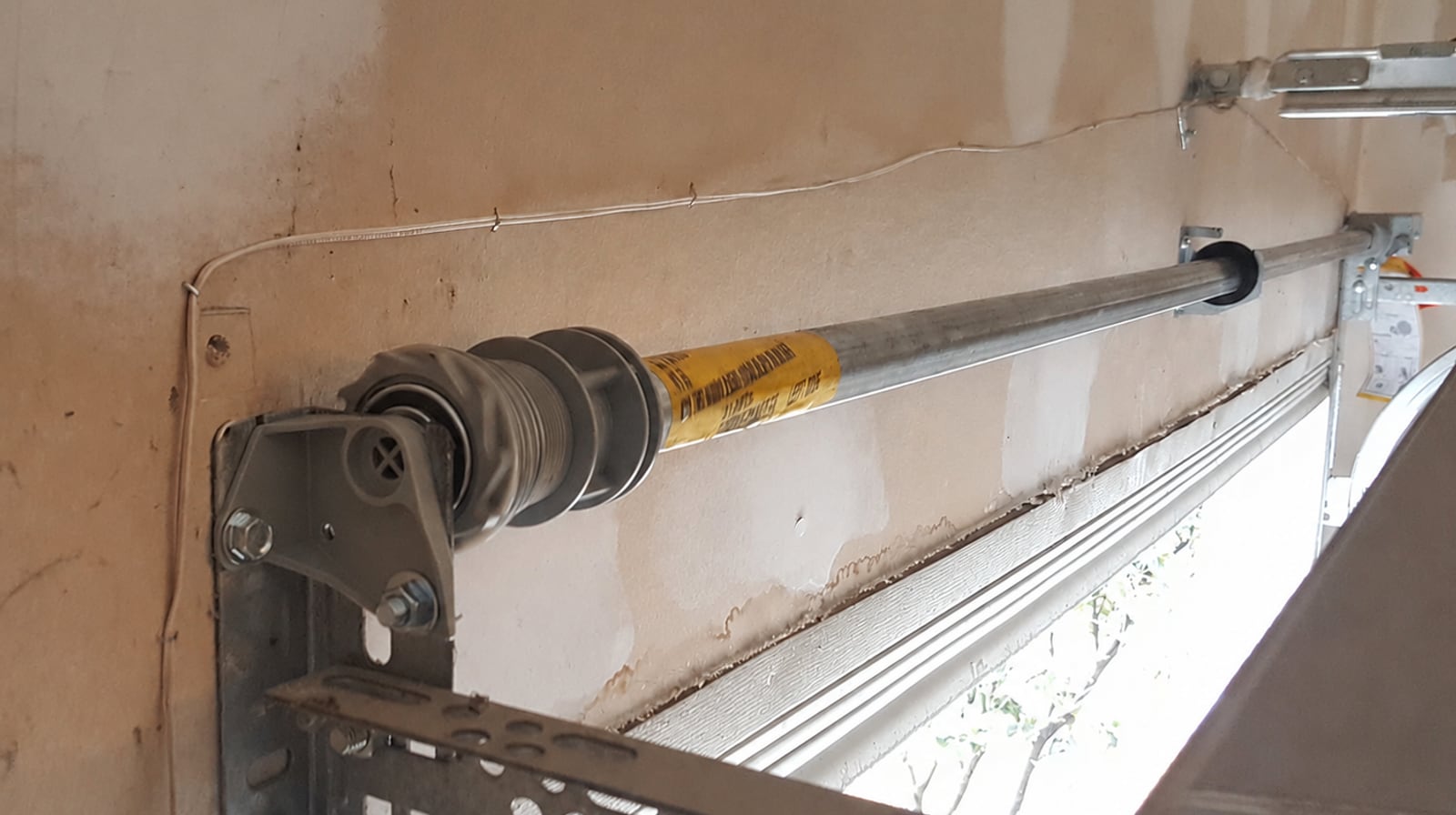
Wayne Dalton introduced the TorqueMaster system in the early 1990s. The pitch was "safer and prettier" — instead of an exposed coiled spring above your door, the spring lives inside a sealed steel tube. No visible spring, no risk of a homeowner sticking a finger in the wrong place.
Good idea. Bad execution.
What's actually inside that tube
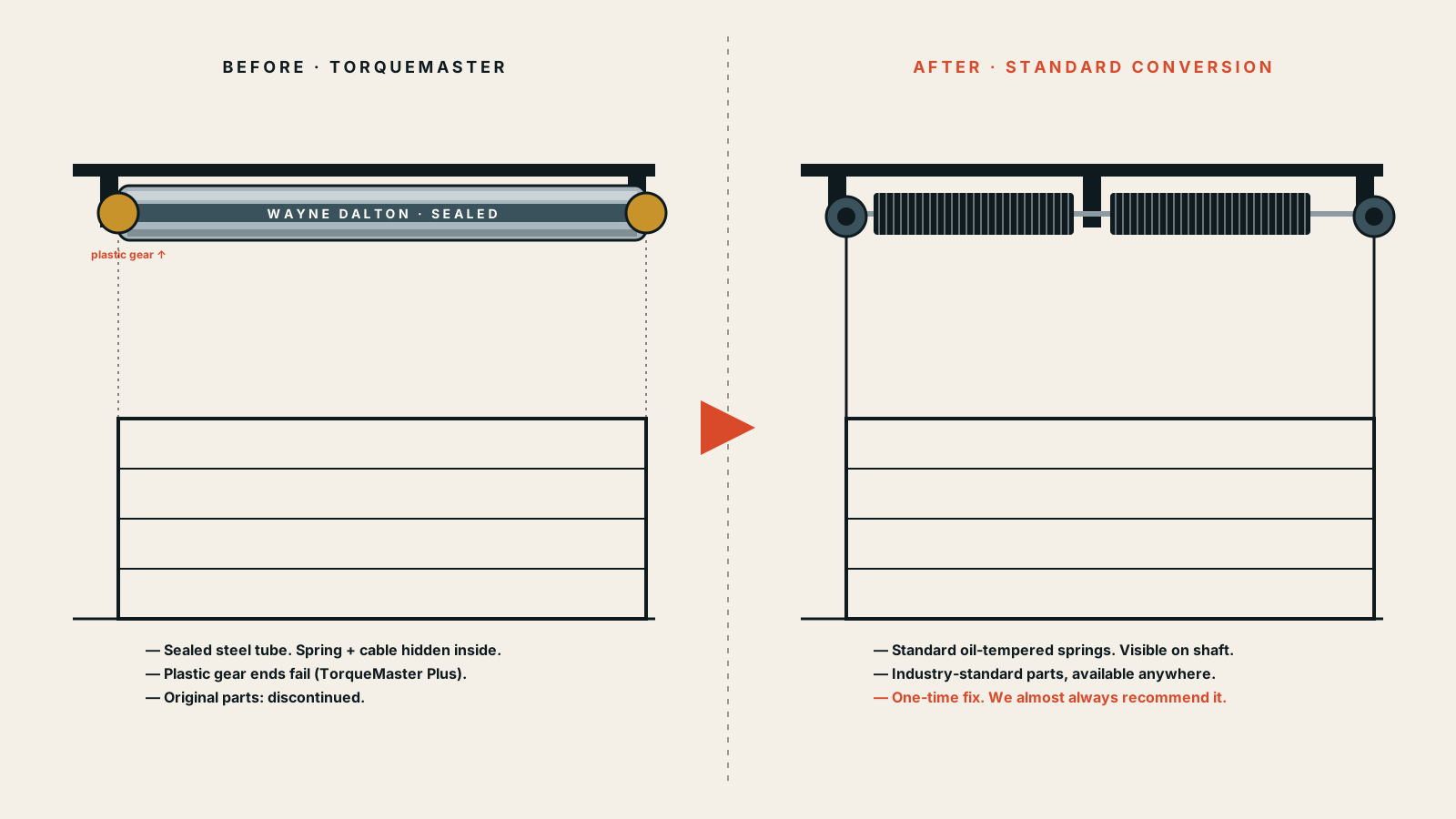
A regular torsion spring, just enclosed. The tube has a winding cone with internal gears that you can engage with a special tool. When the spring breaks, you can't just swap a coil off the shelf — you have to order proprietary parts through Wayne Dalton dealers.
There were two generations:
TorqueMaster (TM One) — 1991 to ~2003
The original. Parts are discontinued by Wayne Dalton. If yours breaks, there is no replacement spring available. Conversion to standard torsion is the only option.
TorqueMaster Plus — 2003 to present
The redesign. Uses internal plastic gears for the winding mechanism. Those gears strip and fail. Replacement parts are technically available but cost almost as much as a full conversion. Lifespan in real-world Vancouver use: 7,000 to 10,000 cycles, vs. 10,000 to 25,000 for standard torsion.
Why most techs refuse them
- You can't see what you're working on.
- Winding the spring through internal gears requires the proprietary Wayne Dalton tool.
- Parts are dealer-network only.
- The plastic gears in TorqueMaster Plus are unreliable — even a "new" repair fails inside a few years.
- Margins are thin and call-backs are common.
We do them. Not because we love them. Because Vancouver has a lot of 1990s subdivisions (Westwood Plateau, Walnut Grove, parts of Fleetwood and Coquitlam) that were built with TorqueMaster as standard, and those homeowners need somebody.
The conversion math
A TorqueMaster repair (parts + labour for Plus model): roughly the same all-in cost as a standard two-spring torsion conversion.
A TorqueMaster conversion to standard torsion: same cost as the repair, but the next time you need new springs (in 8 to 15 years), it's $100 of standard torsion parts instead of $250 of proprietary plastic-gear parts.
So: same money today, much less money next time. That's not how this works — actually, that is how this works, and it's why every honest tech recommends conversion.
What conversion involves
- Remove the TorqueMaster assembly. Sealed tube, winding cones, end caps, internal cables — all out.
- Install a standard torsion shaft. Bracket-mounted to your existing header.
- Install standard torsion springs. Two of them, sized for your door weight. Oil-tempered, visible, replaceable from any garage door parts supplier in the future.
- New cables and drums. Standard residential.
- Balance test, safety test, ready.
The visible look of your door changes slightly — there's now a spring above the door instead of a steel tube. Most people don't notice. If you want to keep the clean look, we can paint the bracket and shaft to match.
"Can I just buy replacement TorqueMaster parts and DIY?"
Don't. For three reasons:
- The internal gears require a specific 8mm hex winding tool, not a standard winding bar. Wrong tool = stripped gear.
- You can't see the spring tension you're working against. With visible torsion, you can count winds. With sealed-tube, you can't.
- TM Plus has factory-set tension that can release suddenly when the gears engage incorrectly. We've seen broken thumbs from this. Don't.
How to tell if you have a TorqueMaster
Open your garage door. Look above the door at the header.
- Visible coiled spring on a shaft = standard torsion. Easy.
- Steel tube about 2 inches in diameter, with end caps = TorqueMaster.
- Springs running horizontally along the tracks on either side = extension. Different system entirely.
If you have a TorqueMaster and it's still working, you don't need to do anything. We'll convert it when it breaks. If it broke yesterday and you've already started Googling, you know what to do.
Conversion price quoted on the phone before we roll. No surprises on site.
Call (778) 800-0769Common cities where we see a lot of TorqueMaster
- Coquitlam — Westwood Plateau executive homes from the 1990s
- Surrey — Fleetwood and Cloverdale subdivisions of the late 1990s
- Langley — Walnut Grove and Murrayville from the same era
- Maple Ridge — older Hammond and West Maple Ridge stock
- Burnaby — pockets of 1990s North and South Burnaby
If you live in any of these and your door has a sealed steel tube above it — you have a TorqueMaster. When it breaks, we're who to call.