
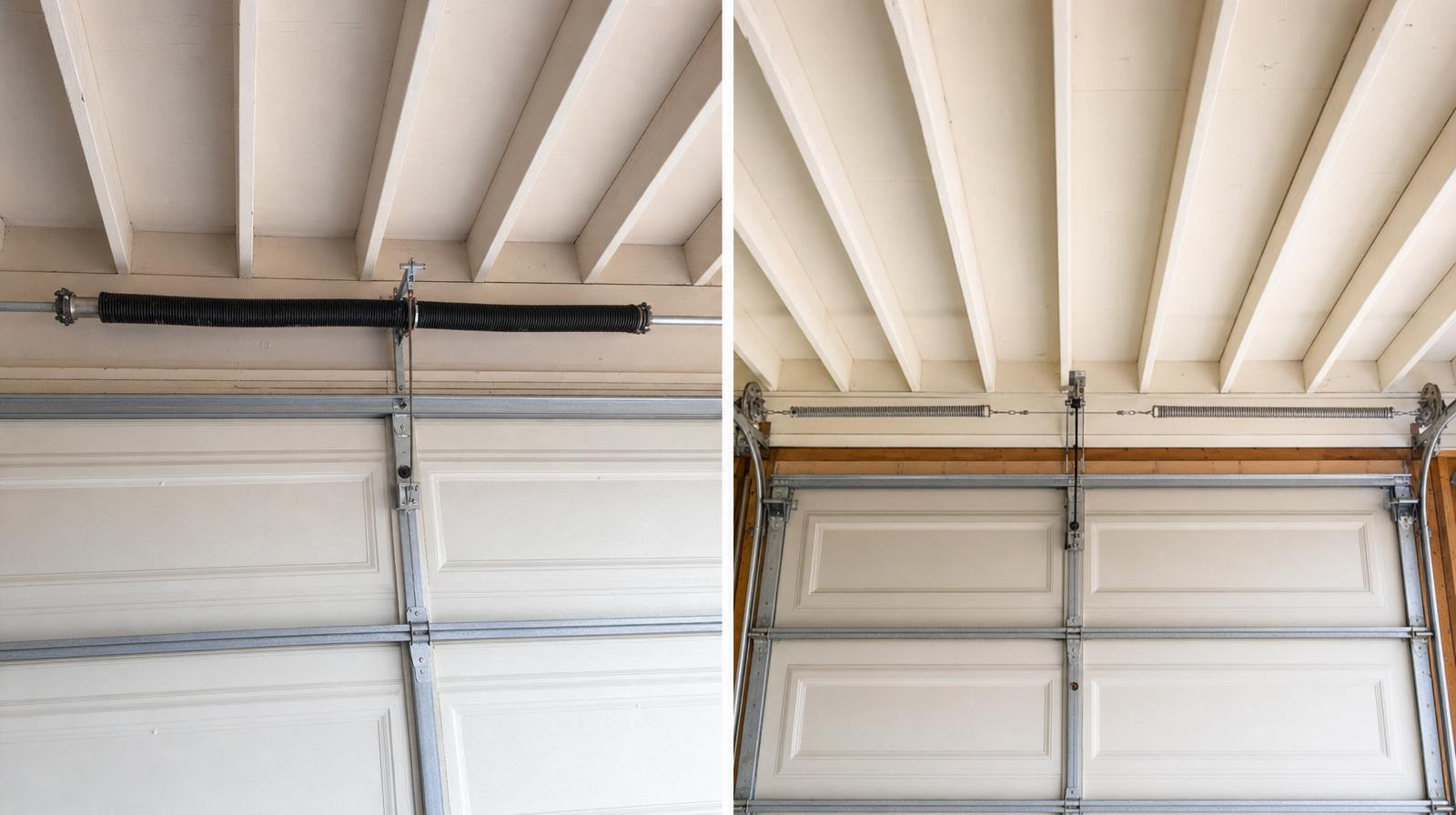
The two spring types do the same job differently: they counterbalance the weight of the door so the opener motor (or your back, if you're going manual) doesn't have to lift 200 pounds of steel by itself.
Torsion springs
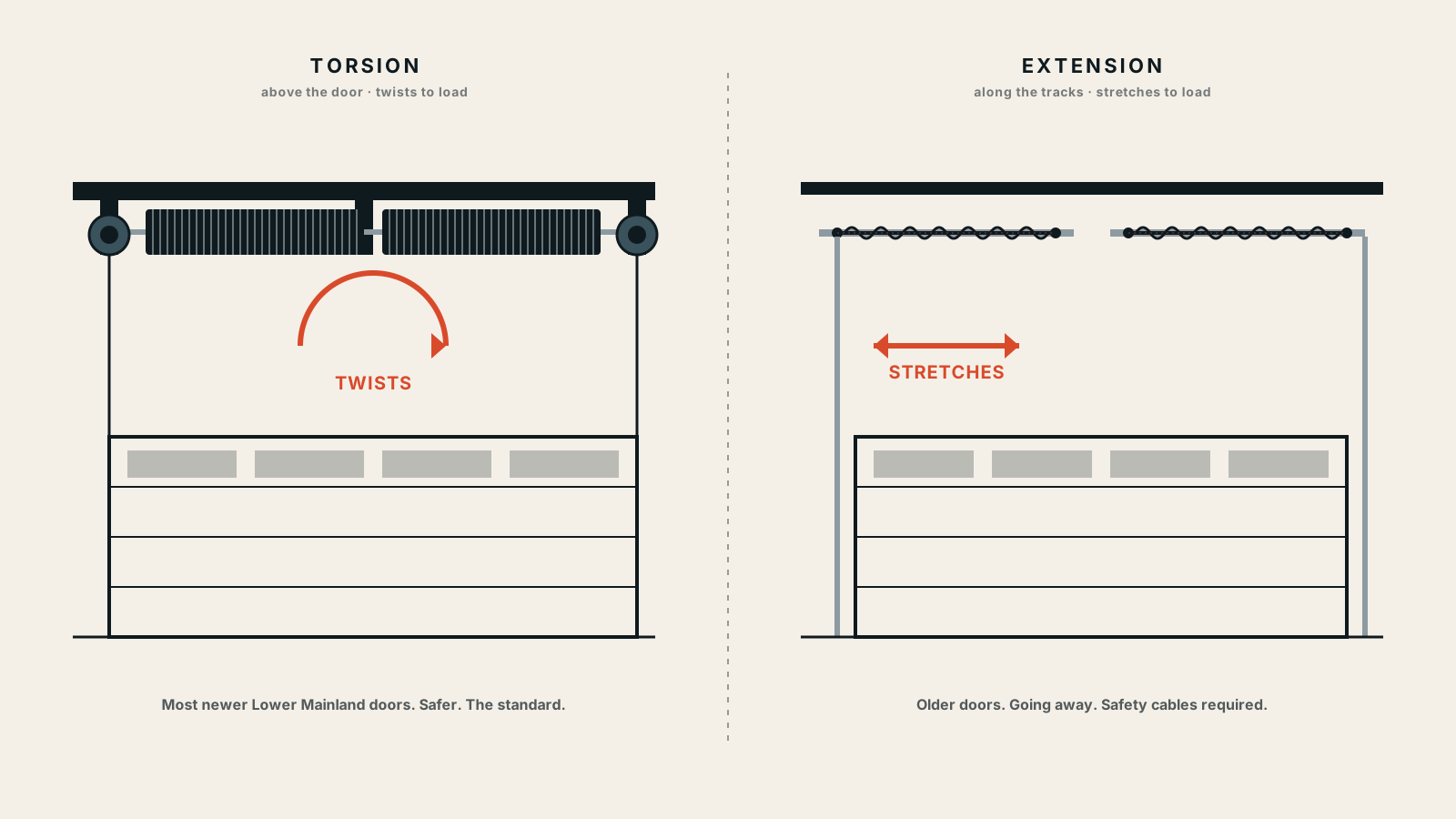
Mounted horizontally on a steel shaft above the door. They store energy by twisting. When the door comes down, the cables pull the drums on either end of the shaft, which winds the spring up. When the door goes up, the spring unwinds and helps lift.
You'll see one or two coils. Most modern residential doors have two. The springs are usually black (oil-tempered, the industry standard) or galvanized silver (cheaper, doesn't last as long in Lower Mainland humidity).
Failure mode: a visible 1- to 2-inch gap in the coil. The two halves spin opposite directions. The sound is a sharp bang, usually loud enough to wake the dog.
Torsion is standard on every modern residential door, every commercial door, and most replacement installs since the late 1980s.
Extension springs
Mounted on either side of the door, parallel to the horizontal tracks. They store energy by stretching. As the door comes down, the springs stretch out. As the door goes up, the springs contract and pull the door open via cables and pulleys.
You'll see two long springs (or sometimes one per side, sometimes two), each maybe 24 to 36 inches long. They hang horizontally.
Failure mode: snap with the broken ends flying at high velocity. This is why extension springs are required to have safety cables running through the centre of the spring. If yours don't have a safety cable, you have a serious problem — not the spring, the missing cable. We won't service an extension setup without cables in place because if it lets go without a cable, somebody dies.
Quick comparison
| Torsion | Extension | |
|---|---|---|
| Position | Horizontal, above door | Horizontal, along tracks |
| Mechanism | Twists | Stretches |
| Lifespan (standard) | 10,000 cycles, 5–10 yrs | 10,000 cycles, 5–8 yrs |
| Safety | Self-contained on shaft | Requires safety cable |
| Modern installs | Yes | Being phased out |
| Cost to replace | Flat-rate, all-in | Usually convert to torsion |
If you have extension, should you convert to torsion?
Often, yes. Torsion is safer, lasts about the same, and runs smoother. Conversion is roughly the same cost as an in-kind extension replacement (since we're installing new shaft, drums, and cables either way). The exception is if your door is on tracks that won't accommodate torsion hardware, which is rare on residential builds — usually only an issue on very old custom installs.
If your house is from the 1960s or earlier and still has original extension springs, you're long overdue. We'll quote both options and let you pick.
What about the cables?
Both systems use cables — different routes, same idea. The cables transmit the spring's force to the bottom of the door. Cables fray and corrode (humidity, salt) faster than springs do. If we're already replacing your springs, cables get replaced for free with the two-spring tier. Skip the cables to save the $120 line item and you're gambling on a $2,300 panel-and-tracks repair when one snaps later.
What about the gauge, length, and diameter numbers?
Torsion springs come in different inside diameters (1¾", 2", 2⅝"), wire gauges (.207 to .295), and lengths (20" to 40" for residential). The right spec depends on door weight and height. You don't need to memorize this — your tech does. We measure on site and pull the right spring off the truck.
Flat-rate, same-day, three tiers, no surprises.
Call (778) 800-0769The door doesn't lie. If it bangs and stops working, it's the spring. If it sags on one side, it's a cable. Either way, call.