
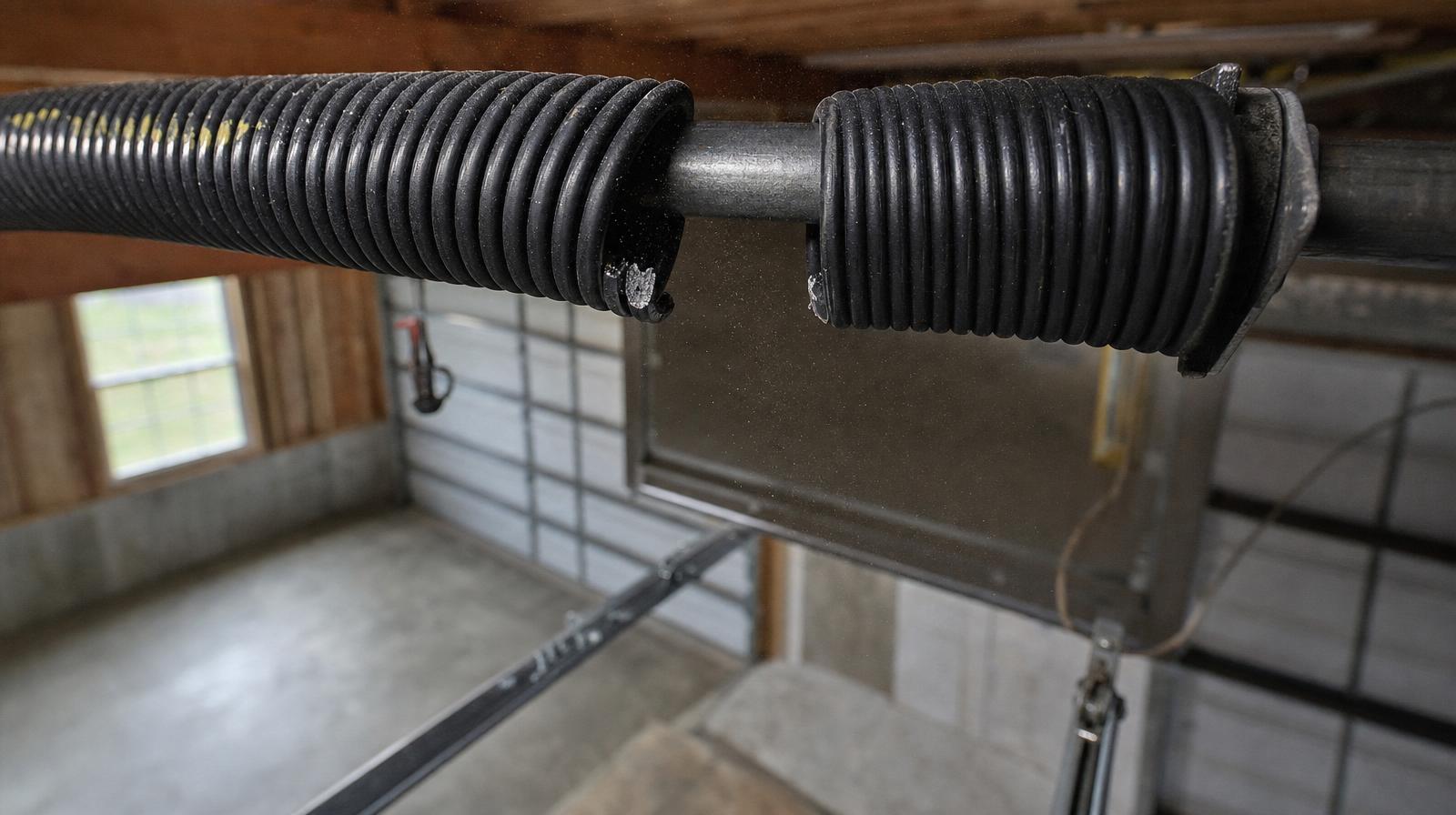
That was your torsion spring. The big horizontal coil above the door. It's been holding 150 to 200 pounds of weight in counterbalance for somewhere between 5 and 25 years, and it just gave up.
It didn't fail because you did anything wrong. It failed because oil-tempered steel doesn't love three months of damp air, one cold snap in February, and 10,000 cycles of you opening the door to drag the recycling bin out. The metal got brittle. The coil got tired. The bang was math.
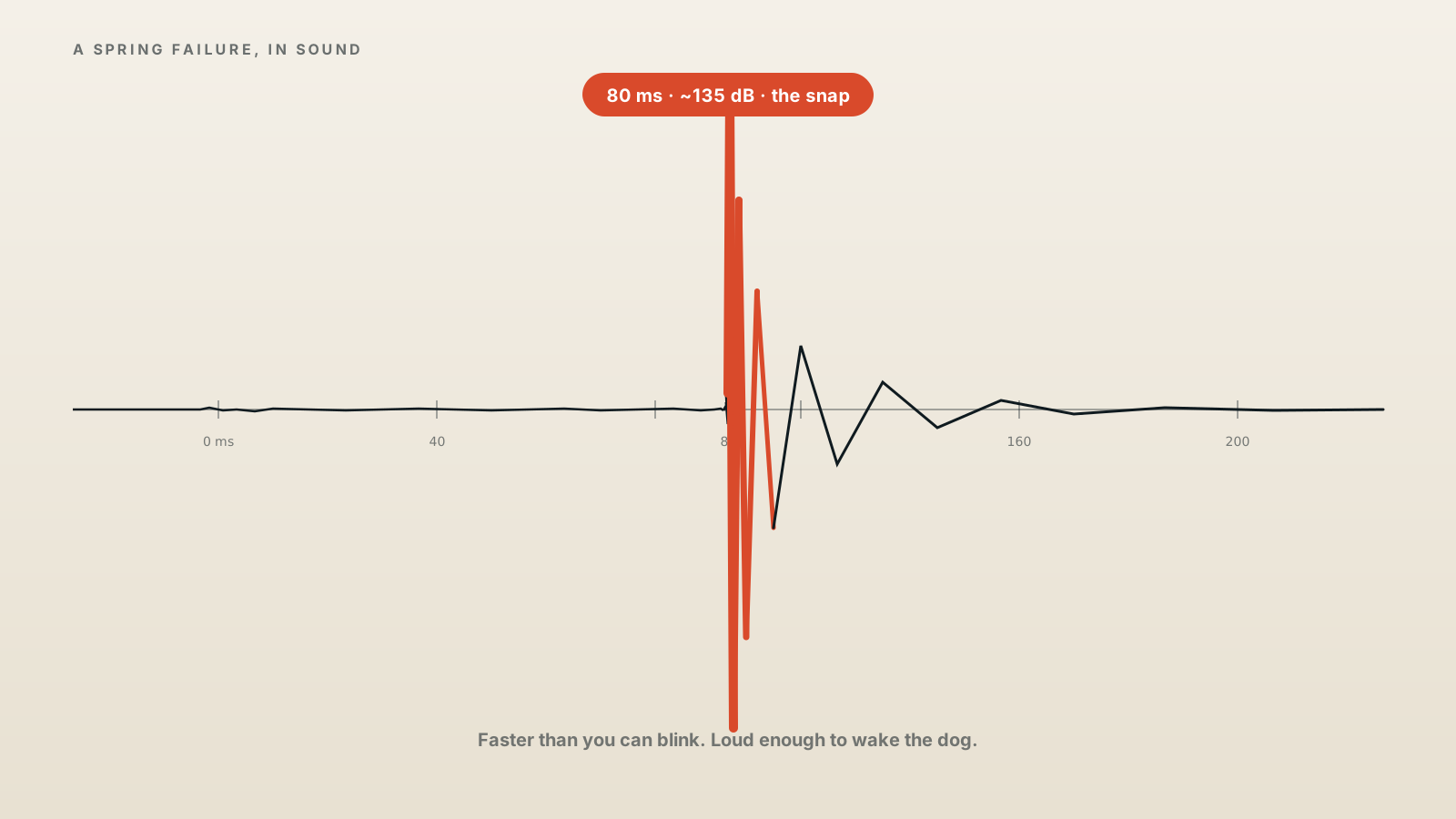
What just happened (in 80 milliseconds)
A residential torsion spring is loaded with 200 to 400 pounds of stored energy when wound. When it cracks, that energy releases in roughly 80 milliseconds — faster than you can blink. The two halves of the broken spring spin opposite directions on the shaft. The crack itself usually leaves a visible 1- to 2-inch gap in the coil. That's the diagnosis.
The sound is loud because the steel is under high tension and the failure is sudden. Inside a closed garage, it's amplified by the empty space. Outside, you might not even hear it. People often describe it as a gunshot, a firecracker, or a 2x4 hitting concrete.
What to do in the next 10 minutes
1. Don't force the door.
This is the most expensive mistake. Without the spring's counterweight, the opener motor is trying to lift the full weight of the door alone — 150 to 200 pounds. It can't. It will try anyway, and you'll burn the gear. Now you have two problems.
2. Disconnect the opener.
Pull the red emergency-release cord that hangs down from the opener carriage. This disengages the opener from the door so the motor can't keep trying. Don't lift the door manually — if both springs are intact you might get away with it, but if one or both have snapped, a 200-pound door lands at terminal velocity. Your back is not a spring.
3. Leave it closed and call us.
The door is safest in the closed position. If it's already partly open, leave it where it is — don't push it. Call us, send a photo if you can (text the same number), and we'll be in your driveway in 12 to 18 minutes if you're in any of our 16 served cities.
Common things people Google at this moment
"Can I replace just one spring?" Technically yes. But the other spring is the same age, has done the same cycle count, and will fail within months. Doing both costs just a little more and saves a second call-out.
"Is it safe to use the opener?" No. The opener wasn't designed to lift the door alone. You'll cook the gear.
"Can I just buy a spring online and DIY?" A 250-pound torsion spring under load is one of the most dangerous things in a residential garage. Industry data: 20,000 to 30,000 garage-door emergency-room visits per year in North America before safety standards tightened. Most were DIY spring replacements. We're not saying this to upsell — we're saying it because we've seen the photos.
What this is going to cost
Three tiers, all-in, plus GST/PST:
- One Spring. Rare. Other spring stays old.
- Two Springs. Includes free cables ($120 value). 5-year parts, 2-year labour. 95% of people pick this.
- Two High-Cycle. 25,000-cycle springs (2.5× standard lifespan). Best for high-use households or if you're staying long-term.
Quoted price equals paid price. No diagnostic fee. No after-hours rate. Same price 7 a.m. or 9 p.m.
Don't keep scrolling. Call.
Call (778) 800-0769The honest version
40% of our calls land between 6:30 and 8:30 a.m. — people heading out for work, hitting the button, hearing the bang, freezing. That's the worst possible moment for a spring to fail, and it's almost always when they do. Cold metal + sudden load + the spring already at end of life = bang.
You're not alone, you're not late, and you didn't break it. The door doesn't lie. If it won't move, it's a spring. Call before noon if you want it fixed today.