
This is the post I've been threatening to write since 2023, because I am tired of telling each customer the same story individually. Here is the story once, in writing, so I can text them this link instead of having the same conversation in their driveway for the fifth time this month.
Setting the scene: the 2009-2010 condo boom
Between roughly 2007 and 2012, Vancouver and the surrounding municipalities issued building permits for an unusual volume of multi-family housing. The Olympic-village construction kicked it off, but the bigger story was the surrounding speculation — Yaletown, Coal Harbour, Brentwood, Burquitlam, central Surrey, central Richmond, Olympic Village proper. Estimates vary depending on what you count, but the working number for new garage-equipped units built in the 2008 to 2012 window across Greater Vancouver is roughly 28,000. That includes townhouse complexes, low-rise condo garages, and ground-level multi-unit garage banks.
Every one of those buildings put in garage doors. Every one of those doors had springs. And every one of those springs was rated to 10,000 cycles. Because that's the minimum legal spec, and builder grade means minimum legal spec.
The cycle math
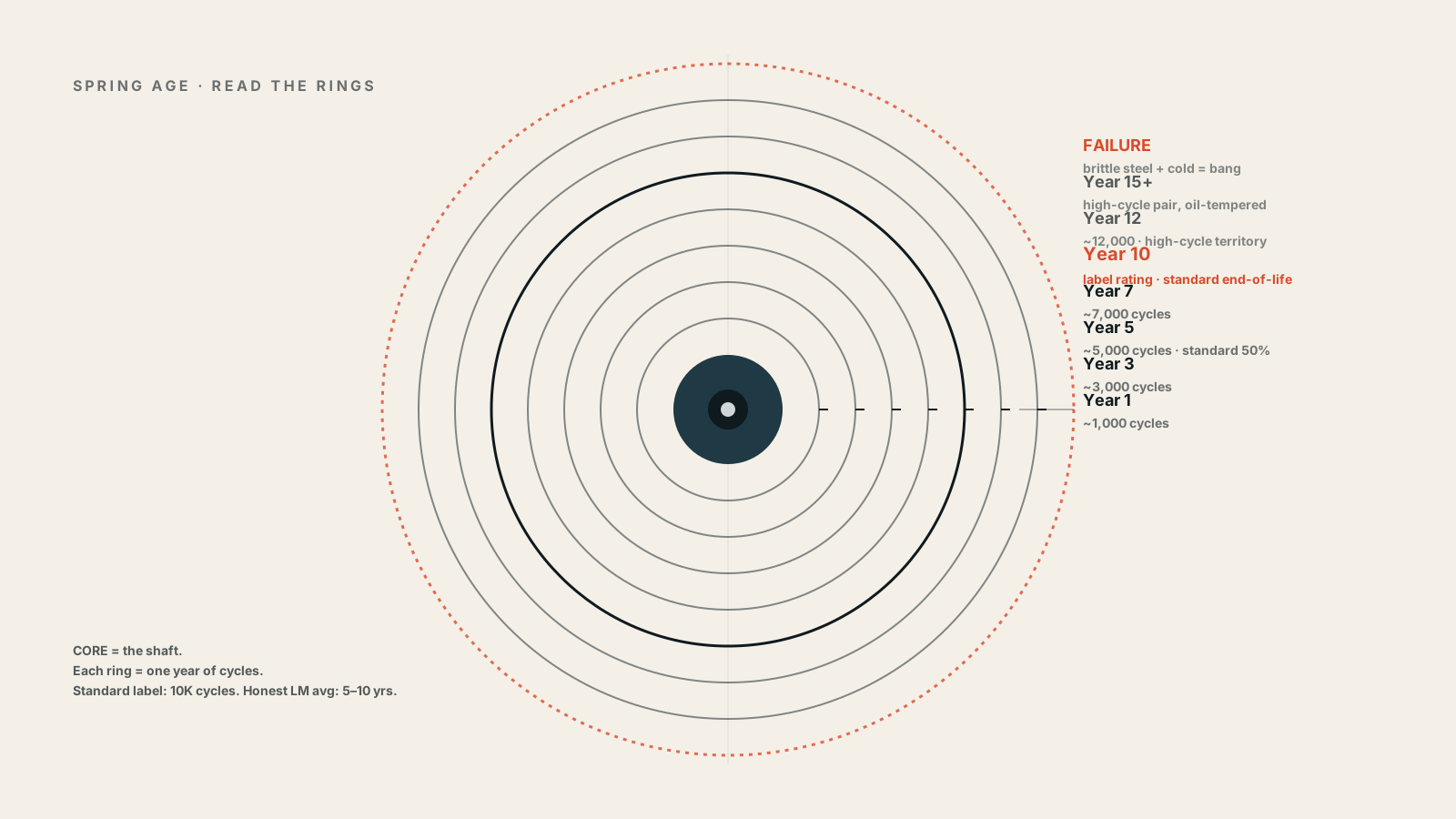
A garage door cycle is one open-and-close. A 10,000-cycle spring is rated to last 10,000 of those before fatigue failure. ("Rated" is generous — real-world lifespan is roughly 7,500 to 11,000 cycles depending on environment, lubrication, and luck.)
| Building type | Cycles/day | Years to 10,000 cycles |
|---|---|---|
| Townhouse, two-car family | 4-6 | 4.5-7 years |
| Townhouse, single retiree | 2-3 | 9-14 years |
| Condo shared bank garage | 40-200+ | 0.5-2 years (high-cycle required) |
| Single-family detached, family | 4-5 | 5.5-7 years |
If the spring was installed in 2010 and the household runs 4 cycles a day, the math says the spring fails between 2017 and 2020. If it's still hanging in 2026, you are statistically on borrowed time. That's not a sales pitch. That's literally what the rating means.
The two manufacturers
The two big builder-grade door manufacturers in BC during that window were Wayne Dalton (now mostly out of the residential market in Canada) and Garaga (still around, more reputable now than then). Both made fine doors for the price point, both used standard 10,000-cycle springs as their base spec, and both had the same end-of-life curve.
Wayne Dalton in particular installed a lot of their TorqueMaster sealed-tube spring system during this period. The TorqueMaster Plus version uses plastic internal gears that don't age well. We have a whole separate post on the TorqueMaster situation — short version, the plastic gears strip and the original parts are discontinued. The honest fix is conversion to standard torsion. We've done about 200 of these in Burquitlam alone.
How to tell if you're an Olympic-vintage door
1. When was the building built?
Check the title or your strata documents. "Built 2009" or "2010" or "2011" — you're in the window. Even "2008" or "2012" — you're close enough.
2. Have the springs ever been replaced?
Ask the previous owner. Check your strata maintenance records. If the answer is "I don't know" or "I don't think so," assume not. The strata won't necessarily have tracked individual garage door spring changes per unit.
3. Look at the spring itself.
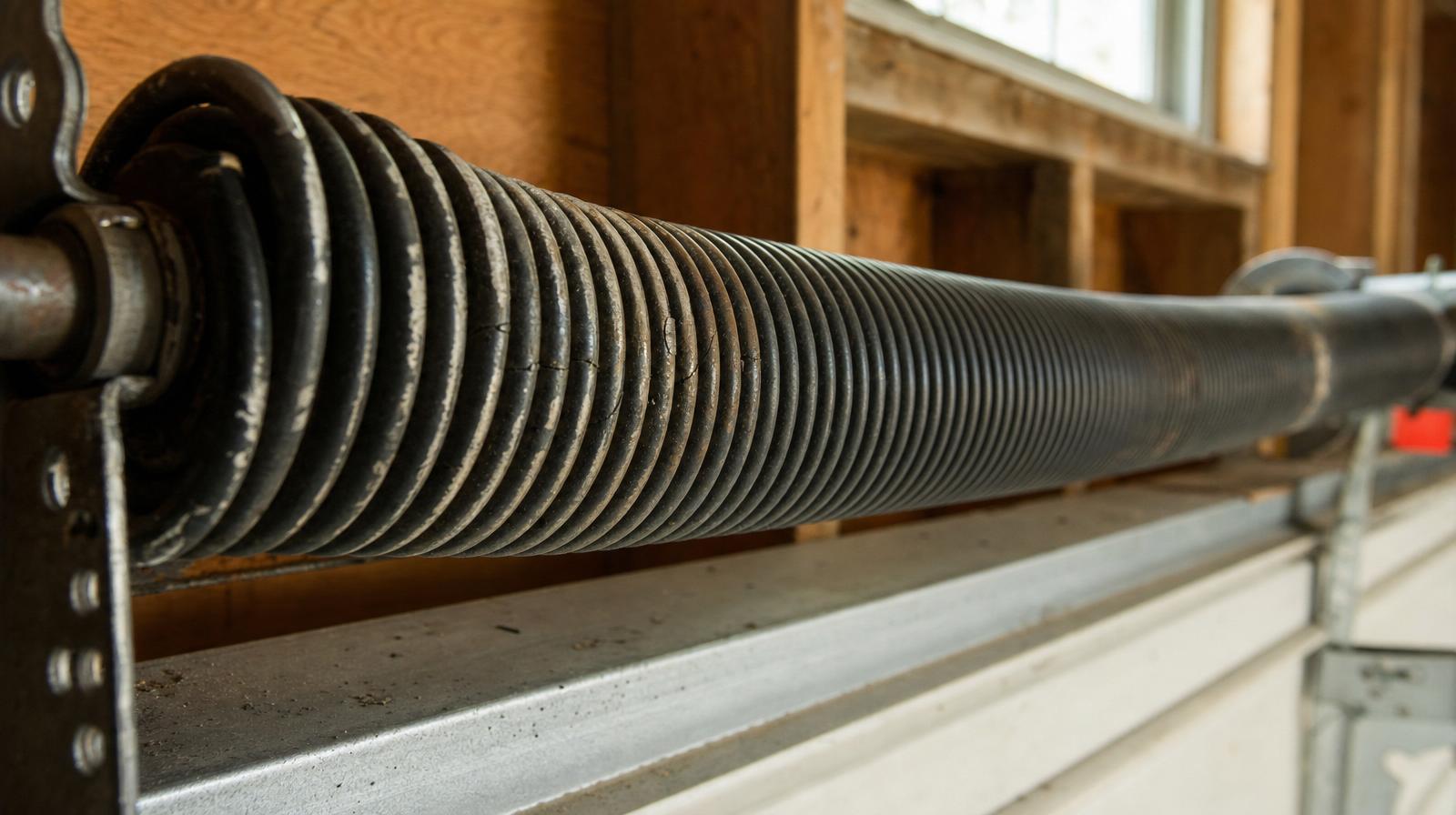
The big horizontal coil above the door. If it's silver-grey, that's galvanized. If it's black with a slight oily sheen, that's oil-tempered. If your 2010 builder put in galvanized in a damp Vancouver garage, the metallurgy is working against you. Oil-tempered lasts longer, period.
4. Look for a colour dot on the cone.
DASMA colour coding — the winding cone on the end of the spring usually has a coloured paint dot. Black = left-wind, red = right-wind. If the dot is clean and crisp, the spring is younger than the building. If the dot is faded or invisible, the spring is original.
Where the failures are clustering right now
- Burquitlam townhouses — large 2009-2012 build-out along Como Lake and Lougheed corridor. Wayne Dalton TorqueMaster is heavily represented. I'm averaging 3-4 calls a week here.
- Brentwood / Lougheed condo low-rises — bank garages with shared doors. These needed high-cycle springs from day one. Many didn't get them. Cycle count is brutal.
- Olympic Village proper — newer city housing, mix of grades, some sealed-bearing models are holding up better. Mileage varies.
- South Surrey / Morgan Heights — large 2010-2012 townhouse stock, Garaga heavy. Failures are real but typically simpler — straight spring swaps.
- Walnut Grove and Willoughby Heights — Langley townhouse boom of the same era. Same story, different traffic.
- Coal Harbour and Yaletown — fewer cars-per-unit, lower cycle counts; failures are slower but real.
What's the legacy actually worth
The 2010 Olympics gave us a SkyTrain extension, an inner-city velodrome that became condos, a brand reputation that's still cashed for tourism marketing, and a generation of housing nobody can afford. (Yes, I lived in an East Van basement suite for $1,500 in 2014 — you can stop telling me how cheap that was.) The garage door legacy is less photogenic, but it's quietly real: roughly 28,000 doors hitting end-of-life on roughly the same timeline. The good news is the second-generation install is almost always better than the first, because we're not bidding for a building — we're servicing a home.
What we put in instead
When we replace an Olympic-vintage spring set, we change four things in the spec:
- Oil-tempered, not galvanized. Lasts longer in the climate. Same install labour.
- Cables come with the two-spring tier free. Builder-grade cables are 16 years old too. They go now.
- Sealed bearings on the shaft. The original shaft bearings on most builder doors are unsealed and have grit in them by now. Sealed costs $40 in parts. Cheap insurance.
- High-cycle option offered honestly. If you're going to live in the place for another 10 years and you run 5+ cycles a day, 25,000-cycle springs make math sense. If you're going to sell in 2 years, the 10,000-cycle two-spring tier is the right answer.
The honest bit
I'm not going to pretend the Olympics ruined Vancouver garage doors. The Olympics did what they were going to do — they put a lot of housing up, fast, at minimum spec, and now we live with the consequences. It's the same story as the cheap windows, the cheap baseboards, and the panel-ready dishwashers that won't fit a 2026 panel. Builder grade is builder grade. The fix is to replace the part that fails with a better part.
If your building is 2008-2012 and your door is acting weird — the opener straining, the lift feeling heavier, a noise that wasn't there last year — book the call. The door doesn't lie. The math doesn't either. Call before noon.