

I'm going to do the rant first because it's the part everybody needs.
WD-40 is not a lubricant.
It says it on the can. It says it on the company website. It says it in the SDS sheet. WD-40 is a water-displacing solvent — that's literally what the WD stands for, Water Displacement, 40th formulation. It was invented in 1953 to stop rust on Atlas missiles. It is a thin penetrating oil that strips other lubricants off metal and then evaporates within a few days, leaving the metal more exposed than it was before you sprayed it.
The reason every Reddit thread, every Facebook neighbourhood group, and every father-in-law in Coquitlam swears by WD-40 for garage doors is that it does, briefly, make a squeaky hinge quiet. For about a week. Then the residue dries, the hinge attracts dust, the dust mixes with what's left of the carrier fluid, and you've got a sticky paste that's worse than nothing. Then you spray more WD-40. Then it gets worse. Then you call me.
I am not mad at WD-40. WD-40 is fantastic at what it actually does: cleaning rust, freeing seized fasteners, displacing moisture out of electrical connections that got rained on. It is a tool. It is not the tool for moving hinges. Use it to clean. Don't use it to lubricate. End of rant. We can be friends.
Use white lithium grease. Or silicone spray.
White lithium grease comes in a $9 can at Home Depot, Canadian Tire, or any auto parts shop on Hastings. The spray version is fine — the brush-on tub is overkill for residential. Silicone spray (Permatex, CRC Heavy Duty) is the second-best option and arguably the better choice if you live near salt water — Madison runs it on most Tsawwassen homes.
Why these and not WD-40, motor oil, or 3-in-One:
- White lithium grease — thick, stays put, doesn't drip onto your car. Good operating range -20°C to 150°C, which covers anything Burnaby Mountain throws at it. Won't wash off in an atmospheric river.
- Silicone spray — slipperier than grease, better for rollers and weatherstripping, doesn't attract dust. Reapply twice a year instead of once.
- Motor oil — too thin, drips everywhere, attracts grit. No.
- 3-in-One — actually a decent light oil, fine for the keyed lock cylinder, too light for hinges.
The 5-minute routine — four points, twice a year
Do this in May and November. May because the rainy season is over. November because the rainy season just started. Set a calendar reminder. Or just do it on the long weekend before Family Day and the long weekend before Thanksgiving. Either works.
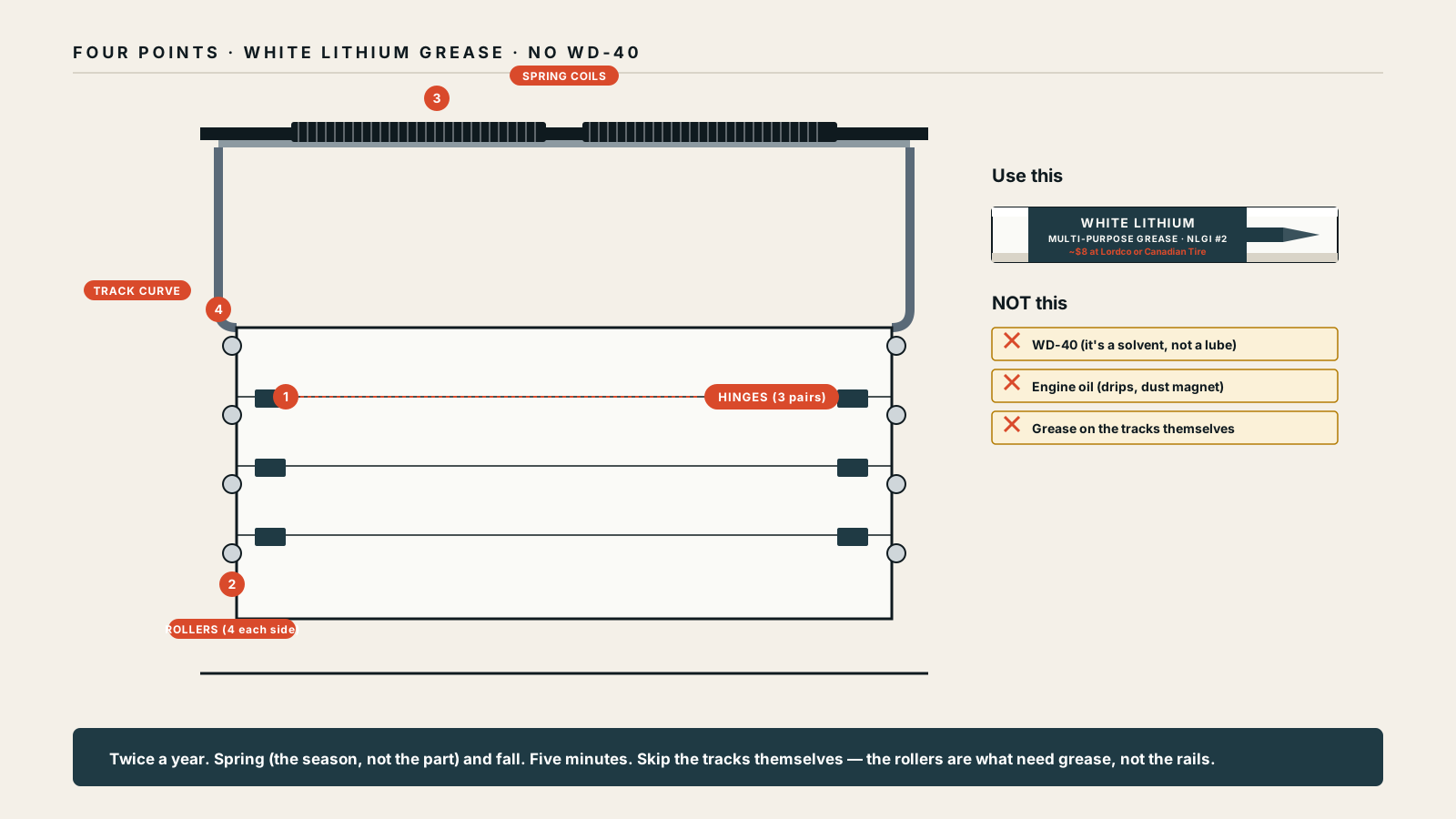
1. Hinges (between every panel)
One short squirt where the hinge pin meets the bracket on each panel joint. There are usually 3 to 5 hinges per side. Don't drown it — a spray-and-count is plenty.
2. Rollers (the wheels in the track)
One squirt where the roller stem enters the bearing. Not the wheel itself — the bearing inside the roller. If you have nylon rollers (white wheel, quieter), use silicone only. Lithium grease can degrade some nylon over years.
3. Spring coils (the big horizontal one above the door)
Light coat along the length of the spring. This is corrosion prevention, not motion lubrication — the coils don't slide, they twist against each other. The grease keeps moisture off the metal and stops the spring from singing in cold weather. Do not stick your hands in the spring area. Spray from a safe arm's length.
4. Top of the torsion tube bearings (ends of the shaft)
The little black brackets at the corners above the door where the shaft enters the bearing — one squirt each. This is the bearing that holds the entire torque load. It deserves the attention.
What to skip
- The track itself. The track is not a lubrication surface. The rollers ride in it. A greasy track collects grit and turns into sandpaper. Wipe it clean with a rag, don't lube it.
- The opener chain or screw drive. Most modern openers come pre-lubed for life. If yours is squealing, it's the drive end bearings, not the chain, and that's a different call.
- The photo-eye sensors. Never. Soft cloth, water only, no chemicals near those lenses. (Madison wrote a whole piece on that for the Richmond fog season.)
- The weatherstripping. Silicone is fine. Lithium grease will stain rubber. Skip if in doubt.
Why this matters more on the Lower Mainland than most places
We live in a temperate rainforest that pretends, for marketing purposes, to be a city. The annual rainfall in Lynn Valley is around 2,000 mm. New Westminster gets about 1,500. Even "dry" Tsawwassen still gets a solid 900-plus. Every fall when the atmospheric river — sorry, the Pineapple Express — rolls in for three weeks straight, every exposed steel hinge and roller bearing in your garage gets a daily dose of humidity. The grease is what stands between the metal and the moisture.
BC Hydro raised rates again this spring, which means your opener is more expensive to run than it was last year. A lubed door pulls roughly 15% less current per cycle because the opener isn't fighting friction. I am not promising you'll notice it on the bill. I am saying the math is on your side.
The honest version
The reason this article exists is that I have seen too many spring jobs that didn't need to happen yet. Twice-a-year lube routine adds 2 to 4 years to the life of an oil-tempered spring. That's a $400-ish savings amortized across the life of the door, for $9 worth of grease and ten minutes of your weekend. Steel's cheap, springs aren't. Call before noon if you want it done today.