

I'm going to do this one honestly, without scaring you, because the topic is already adequately scary and you don't need me piling on. The Cascadia subduction zone is a real thing. The magnitude-9 scenario is a real scenario. There are real things to think about, and there are real things not to lose sleep over. I'll separate the two.
The geology, briefly
The Cascadia subduction zone runs about 1,000 km off the BC, Washington, and Oregon coast, where the Juan de Fuca plate is grinding under the North American plate at roughly 4 cm per year. When it ruptures, it produces what the seismologists call an M9 megathrust — a magnitude 8.7 to 9.2 quake lasting three to five minutes, followed by tsunami waves on the outer coast and prolonged shaking inland.
The last full-margin rupture was 11 p.m. Pacific time, January 26, 1700. (We know the time because the tsunami hit Japan on a documented date and the wave travel time backwards from there gives you the rupture moment. The geology is not vague about this.) The recurrence interval, based on offshore sediment cores, is roughly 200 to 800 years. We are at year 326. That places us inside the window.
None of this means it's happening tomorrow. None of this means it's not. It just means the math is what it is and a sensible person on the Pacific coast plans for it the way a sensible person in Calgary plans for hail.
What the shaking will actually do to a garage door
1. The door panels will not collapse.
Residential garage door panels are sheet steel skinned over a foam or rigid backer. They flex. They don't crumble. In every photographed garage from the 2011 Tohoku M9 — geographically similar event, much better-photographed than 1700 — the doors that failed were the ones whose tracks pulled out of the wall, not the panels themselves.
2. The tracks may pull out of the lag bolts.
The vertical and horizontal tracks are bolted to the wood framing of the garage. In a long-duration shake, those lag bolts can work loose. This is the most common door-related failure mode in moderate-magnitude quakes. Easy to inspect, easy to replace with longer bolts or sleeve anchors if you're worried.
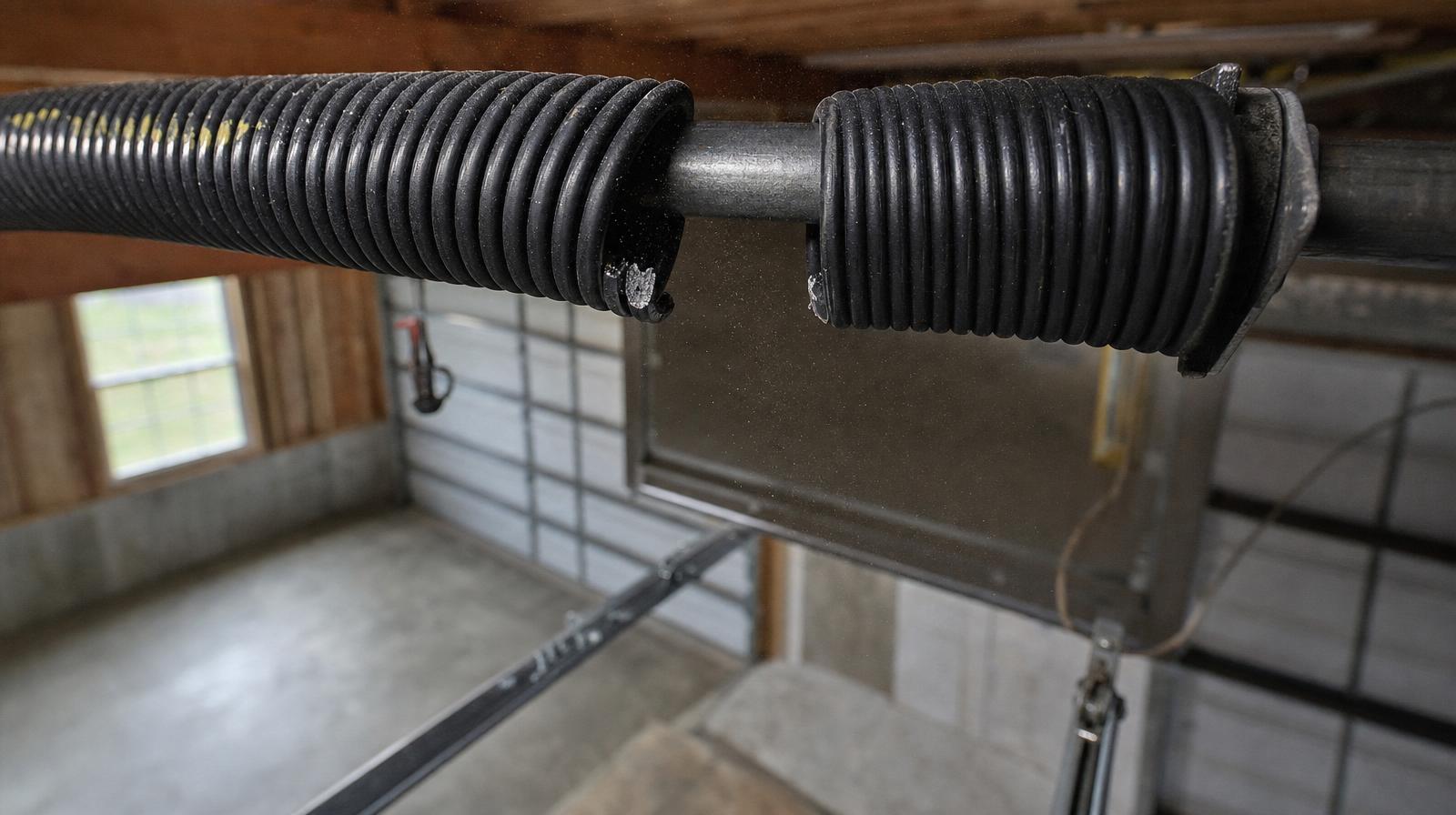
3. The torsion spring will not pop on its own.
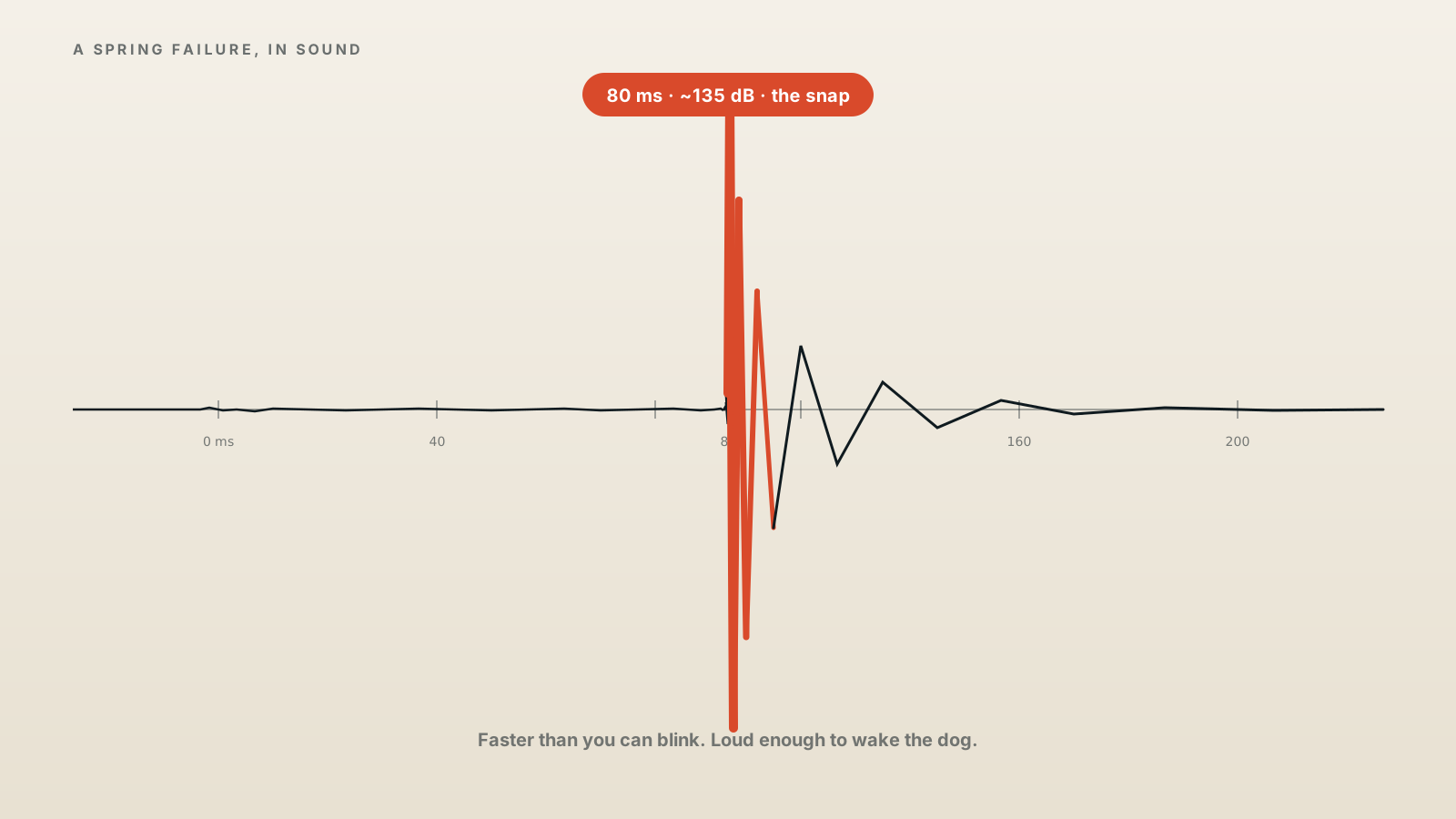
I get asked this every time. A wound torsion spring is held by setscrews on a winding cone bolted to a shaft anchored to a ceiling bracket. None of those connections fail under lateral shake. They fail under fatigue. If your spring is at end of life and the shake happens to be the last cycle, sure, it could go — but the spring was going to go anyway. The earthquake doesn't break your spring. Your spring breaks because it was tired.
4. The opener may dislodge from the ceiling.
This is the one to actually think about. The opener motor weighs 30 to 50 pounds and hangs from two metal straps screwed into ceiling joists. In a long quake, those straps can fatigue. If the opener falls, it can fall on a car, on tools, or on a person standing in the garage. This is preventable. See below.
What to actually do
Step 1 — Check your opener mount.
Look up. The two metal straps holding the opener should be bolted into ceiling joists (the structural lumber), not just into the drywall. If you see drywall anchors or self-tapping screws into nothing, that needs to be redone. Use lag bolts into solid wood. A redo takes 20 minutes and costs $8 in hardware.
Step 2 — Check the wall mounts for the track.
The horizontal track at the top of the door runs back into the garage and is supported by a hanger strap to the ceiling joists. Same story — lag bolts into solid wood, not drywall anchors. If your installer used the right hardware, you're done.
Step 3 — Don't store heavy stuff above the door.
That overhead storage rack with the camping gear, the Christmas tree stand, and the box of tile you've meant to return to Home Depot since 2019? In a shake, that's all coming down. Move it to a corner, not above where your car parks. This isn't about the door — it's just better.
Step 4 — Know how to manually disconnect the opener.
The red emergency-release cord. If the power goes out — and BC Hydro will be out for days to weeks after a major event — you need to be able to get out of your garage by lifting the door manually. Test the release once. Practice once. The first time you do this should not be at 3 a.m. with no power, no cell signal, and a panicking spouse.
What strata buildings should care about
If you're on a strata council with an underground garage and a big communal door:
- Confirm the depreciation report addresses the door system — many don't. The 2014 BC strata legislation requires depreciation reports for buildings of 5+ units; the door is often listed as a single line item with no detail.
- Ask whether the opener and track mounts were specced for seismic load. Most builder-grade installs were not.
- Maintain a manual-open-able alternative for power-out evacuation. Some larger commercial doors have a chain hoist; some need a battery backup; some need a separate person door. Plan it before you need it.
- Keep a paper list of how to override the gate in a strata building. The list is no good if it's only on the strata manager's iPhone, which is in their condo, which is also without power.
What not to worry about
- The door panels caving in on your car. Doesn't happen at residential scale.
- The spring releasing during the shake. Very unlikely; happens at end-of-life only.
- Needing some kind of "earthquake-rated" spring. There isn't really such a thing in residential. The standard hardware, properly installed, is fine. Installation quality matters more than spec.
- The cables snapping from the shake. Cables fail from corrosion and fatigue, not from lateral motion.
The new Massey Tunnel is the lesson here
I mentioned in another post that the current Massey Tunnel is not rated for the Big One and the new one will be. That's the model — the new structure is designed for the actual event, the old structure is being kept running until the new one opens. Your garage door is similar. The original 1990s install probably wasn't thought about in seismic terms. The second-generation install (the one we'll do when your spring fails) is when you fix the mounting hardware. Same call, twenty extra minutes, no extra labour cost.
The honest bit
I'm not in the earthquake-prep business. I'm in the spring business. The reason I wrote this is that customers ask, and the answers I see online are mostly written by people who don't service doors for a living. The summary is: your garage door is unlikely to be the thing that hurts you in the Big One. Your mounting hardware might be. Your power-out evacuation plan might be. Those are fixable in an afternoon.
The water and food kits are not my department. The mounting hardware is. Same family. Same number. Call before the next CBC article comes out.