
This is the post I've owed you since 2021. Every November when the first big rain event rolls in, my call volume doubles, and almost all of it is cables. Not springs. Cables. Here is why that happens, what the 2021 event specifically revealed, and what you can do about it before the next one.
What an atmospheric river actually is
An atmospheric river is a narrow, fast-moving band of water vapour in the upper atmosphere — picture a 400-km-wide hose of moist Pacific air pointed at the BC coast. When it hits the Coast Mountains, the air rises, cools, and dumps the moisture as rain. A strong atmospheric river can deliver more water in 48 hours than the Lower Mainland normally sees in a month.
We used to call this the Pineapple Express, because the moisture source was usually near Hawaii. Sometime around 2017, the term "atmospheric river" took over in the meteorology press — partly because it's more technically accurate, partly because "Pineapple Express" was also a Seth Rogen movie and the news anchors got tired of saying it on serious broadcasts. Same weather. New name. The rain doesn't care what we call it.
The November 2021 event, briefly
November 13-15, 2021. An atmospheric river parked over the Lower Mainland for 36 hours and dropped between 200 and 350 mm of rain depending on where you measured. Abbotsford got hit hardest — the Sumas Prairie pump station was overwhelmed and 1,100 properties flooded. The Coquihalla and Highway 1 east of Hope were destroyed in multiple sections. Damage estimates ran past $1 billion provincewide.
From a garage door service standpoint, the event didn't damage any doors directly. What it did was concentrate three months of cable corrosion into a single weekend, and then I spent November and December cleaning up the failures that followed.
Why cables fail before springs
I've said this before in the coastal corrosion post but it's worth saying again here, because it's the central fact:
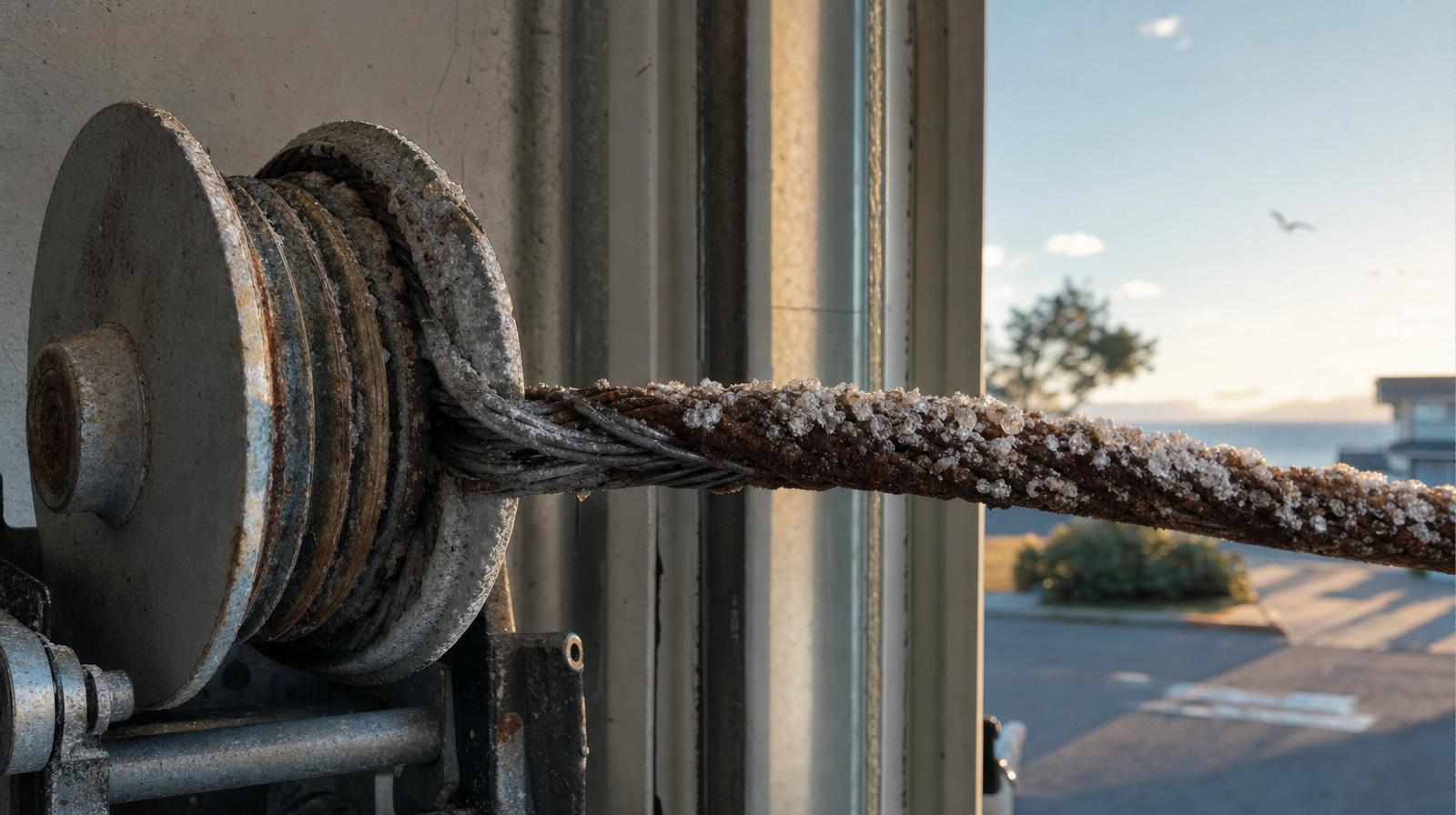
A garage door cable is a bundled steel wire about 1/8" thick, with maybe 50 individual strands twisted together. The total surface area exposed to air, per pound of metal, is roughly five times higher than the equivalent on a spring. Five times more chance to oxidize. Five times faster to fatigue from corrosion-induced pitting.
Cables also live near the bottom of the door. The bottom of the door is the wettest part of the door. Rain blows in under the seal. Condensation forms on the floor. Snow drifts melt against the bottom panel. The cable terminates in a steel bracket at the bottom corner, and that bracket spends its life sitting in a small puddle of whatever the weather delivered.
By the time you see the spring give up, you've already had a cable problem for months and just didn't know it.
The 2021 lesson — humidity isn't a coastal problem anymore
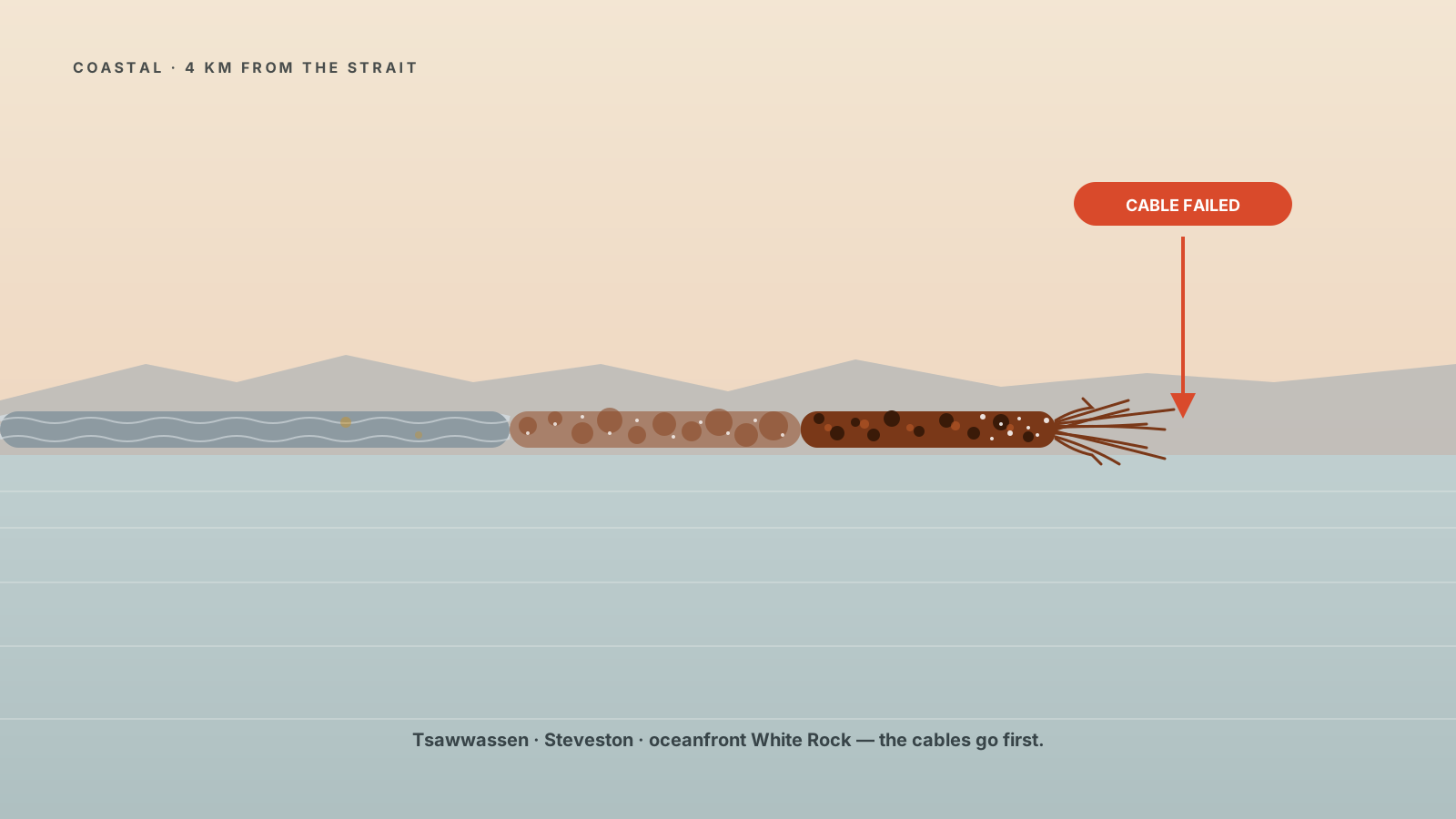
Before 2021, we treated humidity as a coastal-spec issue. Tsawwassen, oceanfront Steveston, the dyke in Ladner — those got stainless cables and the inland addresses didn't. After 2021, that's not how I think about it. The atmospheric river dumped Pacific moisture across the entire Lower Mainland for two days straight. Cables in Maple Ridge, Pitt Meadows, Mission, and Abbotsford rusted on a coastal timeline because, for 36 hours, they were exposed to coastal humidity.
Climate scientists are pretty clear that atmospheric rivers are getting more frequent and more intense in the eastern Pacific. We've had significant events in 2021, 2022, 2023, and 2024. The expectation is that this is the new pattern, not an outlier. Plan your cables for that, not for what the climate was in 2015.
What you actually see when a cable fails
The first symptom — a noise.
A frayed cable singing under load makes a high thin whine that wasn't there last month. If you hear something new during a door cycle, that's where to look first.
The second symptom — one side hangs lower than the other.
If one cable stretches or partly fails, that side of the door drops slightly when closed. Stand in front of the door and look at the bottom edge. Level? Good. Tilted? Cable.
The third symptom — the door slams down or won't close evenly.
One cable has let go entirely. The remaining cable is doing all the work and the door is wildly out of balance. Stop using the door. The next cycle could drop a 200-pound panel.
What we do differently for each city
- North Vancouver and West Van — Highest rainfall in Metro Vancouver, 1,800 to 2,500 mm/year. Oil-tempered springs and oil-treated galvanized cables as a minimum, stainless cables on direct-water-view properties. Lynn Valley gets the rain. Deep Cove gets the rain plus the salt.
- Tsawwassen, White Rock, oceanfront Richmond — Salt is the dominant variable. Stainless cables, oil-tempered springs. Twice-yearly fresh-water rinse helps.
- Maple Ridge, Pitt Meadows, Mission — Used to be inland-spec territory. Post-2021, we run oil-treated galvanized cables here too. Atmospheric river country.
- Surrey, Langley, central Burnaby — Standard oil-tempered, galvanized cables. The 2021 event lasted long enough to affect everyone, but inland addresses still rust slower than coastal.
- Pitt Meadows specifically — Fraser-Pitt floodplain humidity is high year-round. Cables here fail before springs, every time. We carry extra spares for this city alone.
What you can do between service calls
Look at the cables once a month, from a safe angle.
Open the door halfway and look at the bottom corner where the cable terminates. You're looking for visible rust, fraying, or any difference between the left and right cables. Don't touch. Don't reach in. Just look. If one cable looks different from the other, that's the call.
Don't let water pool at the bottom of the door.
If your garage floor slopes toward the door (most do), and the weather seal at the bottom is worn, water tracks in under the door and sits at the base — exactly where the cable lives. A $20 bottom seal replacement once every 5 years is the cheapest cable insurance there is.
Wipe the cable terminations dry after a major rain event.
I'm not asking you to do this every week. I'm saying after a big atmospheric-river day, take a dry towel to the cable end where it attaches at the bottom corner. Two minutes. Maybe twice a winter. Adds years.
The honest bit
The cable is the cheapest part of a spring job. It's also the part that fails first and the part most homeowners forget exists. The reason we include free cables with the two-spring tier isn't generosity — it's that we've learned the hard way that doing the springs without doing the cables means we'll be back in 18 months. The atmospheric river didn't change our spec — it just made the spec we were already running look smart in hindsight.
Call when you hear a new noise. Call after a big rain. Same family. Same number.