
Why every house up here has the same spring system
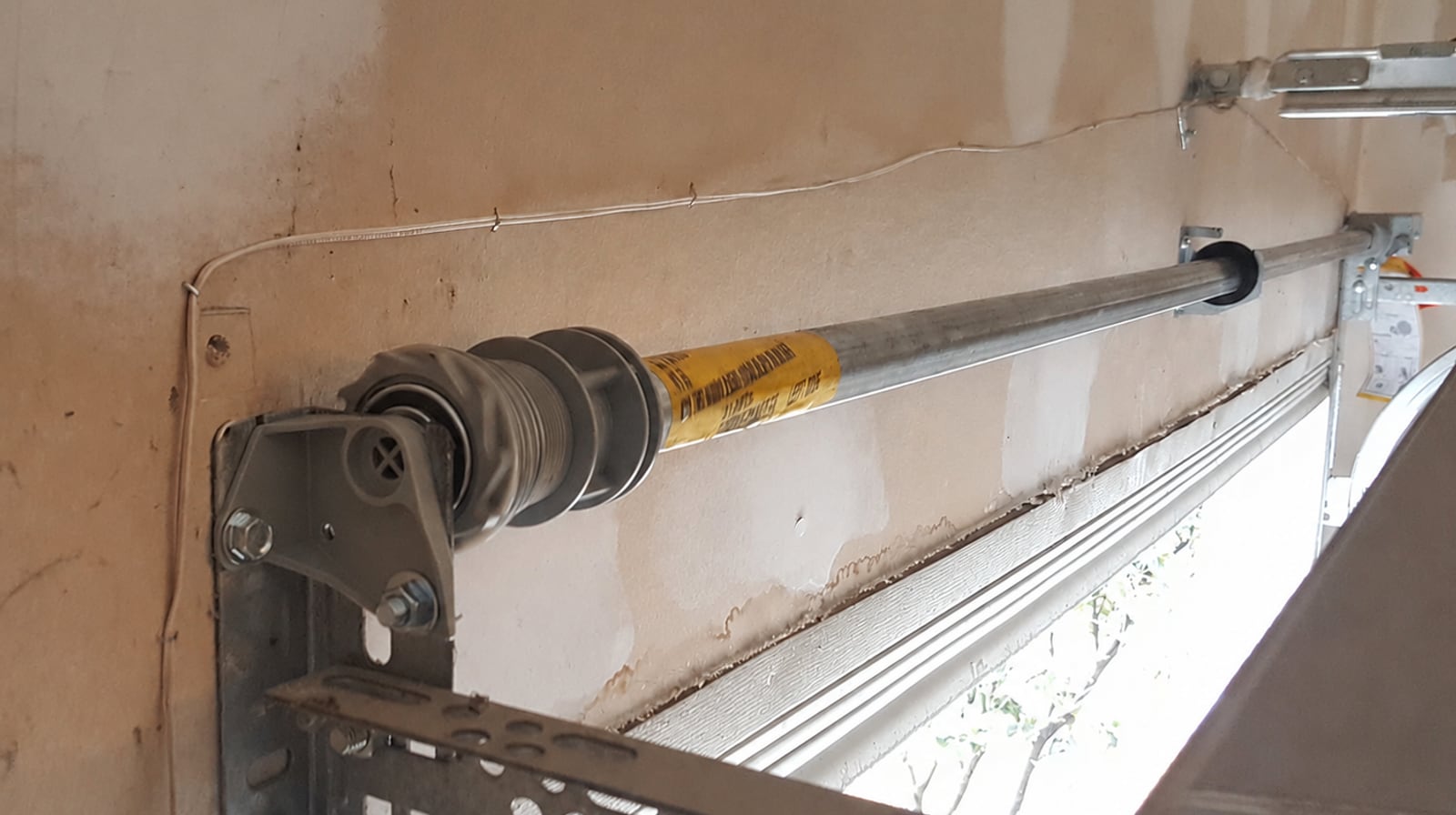
Production homebuilders in the late 1990s loved TorqueMaster for one reason: install speed. A standard torsion spring requires a tech with winding bars, calibration time, and a balance test. A TorqueMaster came pre-engineered for the door — bolt the tube up, snap in the cones, wind it with a power drill, done in 20 minutes. For a builder pushing 8 homes to closing per week on the Plateau in 1996, the math was obvious.
Polygon, Morningstar, Adera, Imani Custom — the names on the original builder badges in the breaker boxes up here — they all spec'd Wayne Dalton 9100s with TorqueMaster Original as the standard fit on the 16×7 double-car. A handful of the larger homes on Pinnacle Ridge, Plateau Boulevard, and Eastside Drive got 9100s with the triple-car configuration, two TorqueMaster tubes side by side. Same system, twice the failure surface.
What's breaking, and why now
The math is unforgiving. Wayne Dalton's own marketing says TorqueMaster Originals hit the ANSI/DASMA 102 minimum of 10,000 cycles. Field reality: in a Westwood Plateau home with three vehicles cycling through a single garage door three or four times a day, you reach 10,000 cycles in about six and a half years. A house built in 1996 has run through two or three spring sets by now. Whatever's in there today is the third generation, often installed by whoever did the last service — sometimes correctly, sometimes not.
Heritage Mountain elevation makes it worse. The Plateau sits between 280 and 410 metres. From November through March, you get sustained sub-zero mornings the Coquitlam flats never see. Cold steel is brittle. A spring that has 1,500 cycles left at 12°C might give up at -4°C on a Tuesday morning when the homeowner mashes the opener button on the way to school drop-off. The break is sudden and complete: a single bang you can hear from the kitchen, the tube spins freely, the door won't open, the opener motor strains and trips.
Then there's the Original-system gear problem. The plastic worm drive and main gear inside the TorqueMaster end-bracket were designed for a corded drill at moderate torque. Plenty of homeowners and even some installers used impact drivers, which strip the gear teeth in one pass. We've replaced four TorqueMaster Original drive-gear assemblies on the Plateau in the last month. Wayne Dalton discontinued that part as of 2025. There is no replacement.
What we actually do when we get there
Two paths. Replace the springs in-kind (TorqueMaster Plus conversion kit), or convert to standard torsion. We almost always recommend convert.
Why: standard torsion is universal. Any garage door shop in BC can service it. The springs are commodity parts, not a proprietary order from a Wayne Dalton dealer. You can buy 25,000-cycle high-cycle springs that last 2.5× longer than anything Wayne Dalton ever made. And on a Westwood Plateau home with a 25-year service history of TorqueMaster repairs, the math says skip the in-kind swap. Next service should be a $100 standard part instead of a $250 special-order job.
The conversion on a 16×7 9100 takes about two hours. We remove the entire TorqueMaster tube, install a 1-inch steel shaft, end bearing plates, a centre support bearing, and conventional torsion springs sized for the door's actual weight. Cables and drums get replaced as a matter of course because the existing ones are corroded.
The Plateau-specific spec we recommend
For Westwood Plateau homes — especially anything above 350 m elevation — we install the high-cycle (flat-rate, all-in) over the standard two-spring tier. The freeze-thaw on Eagle Mountain Drive, Plateau Boulevard, Pinnacle Ridge, and the higher-elevation cul-de-sacs is real. 25,000-cycle springs at -8°C have measurably more fatigue tolerance than 10,000-cycle springs. The modest premium over the standard tier pays back in years 7 through 12 — exactly the years your second-generation TorqueMasters give up.
If the door is anywhere near a forced-air vent or laundry exhaust, we add sealed bearings instead of the standard open bushings. Those Plateau homes with the laundry room sharing the garage wall — Heritage Mountain Place, Devon Manor, parts of the original Hawthorne sub — they push humid air toward the spring assembly every dryer cycle. Sealed bearings cost us $40 in parts and roughly double the bearing service life.
Coming due in 2026
If your Westwood Plateau home was built 1991–1998, your TorqueMaster is in the highest-risk decade right now. If it was built 1999–2007, you're entering the second-spring-set window. Pre-empt the failure or pay full price for the emergency call — your choice, but the math is on our side.
Same Coquitlam tech. Same flat-rate pricing. ~15 minutes from your driveway. The springs you replace today will outlive the Westwood Motorsport era of street names this neighbourhood was built on.