

The garage door reversing-on-close issue is one of the most common service calls we get from late October through mid-January. It feels personal — like the door has decided it doesn't trust you anymore — but it's almost never the door. It's the photo-eye sensors. And it's a five-minute fix you can do yourself before you call anyone.
Save the $129 for something better. Like a halibut dinner at Pajo's when it finally reopens for the season.
What the photo-eyes do
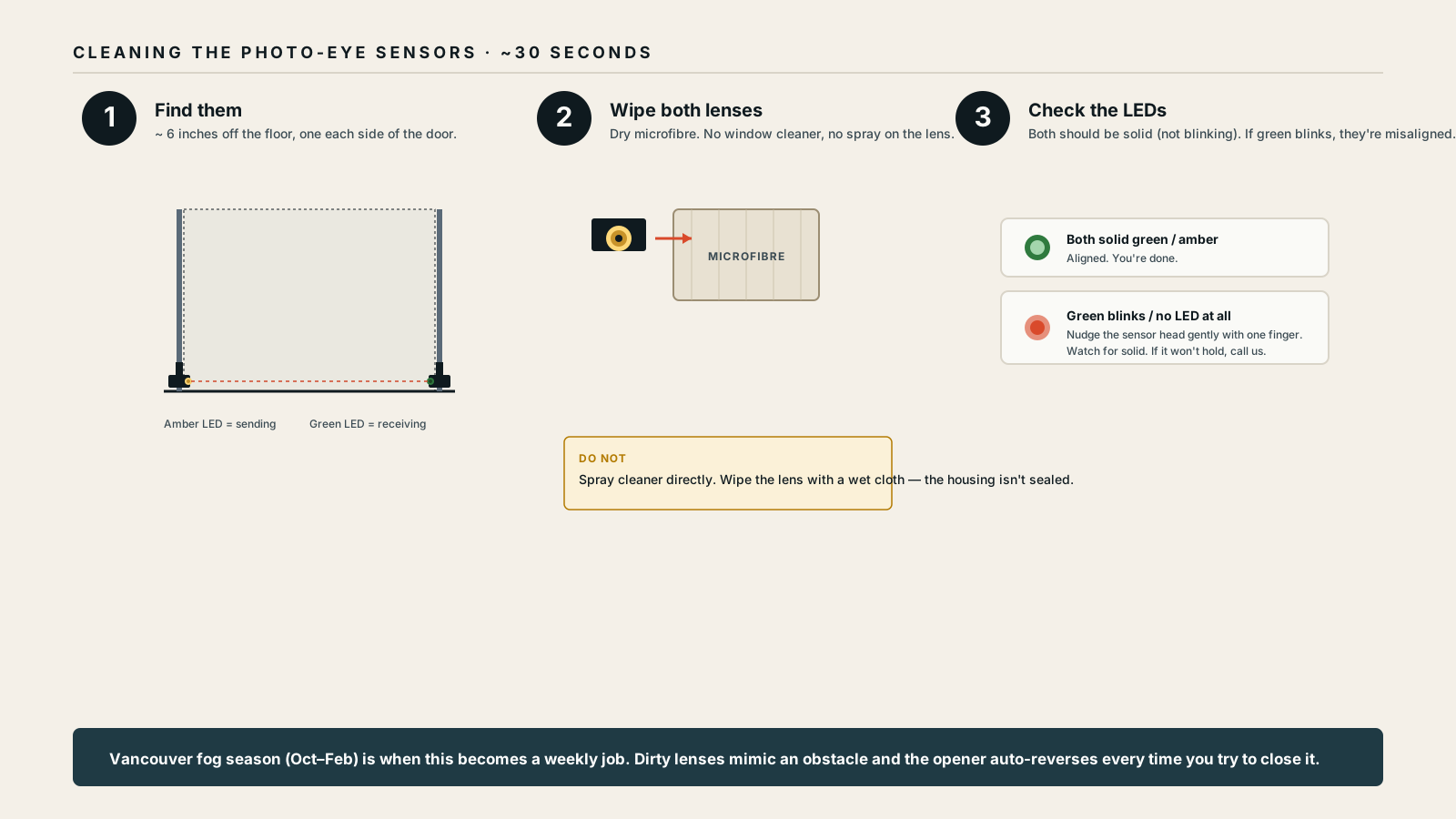
Down by the floor at each side of the door opening, about six inches up, you'll see two small plastic eyes pointed at each other across the doorway. They're the safety beam. Since 1993, UL 325 has required them on every residential opener sold in North America — they're what stops the door from closing on a kid, a cat, a hockey bag, or the recycling bin you left sticking out two inches too far.
The way they work is simple. One eye sends an infrared beam. The other eye receives it. If the beam is interrupted, the opener won't let the door close, and if the door is already closing and the beam breaks, the door reverses — that's the auto-reverse safety. UL 325 spec is reverse within 2 seconds of a beam interruption.
What goes wrong in November
Two things. Both involve water.
1. The lens gets foggy.
Richmond fog isn't just visible fog — it's airborne moisture that condenses on every cold surface for hours after the visible fog burns off. Your photo-eye lens is a cold plastic disc roughly the size of a dime, six inches off a cold concrete slab, facing into an unheated garage. Moisture loves it. By 7 a.m. the lens has a film of micro-condensation that scatters the infrared beam. The door reads it as obstruction. Door reverses.
2. The lens gets dusty, and the dust gets damp.
Garage floors are dirty. Cars track in road grit, leaves blow in, you sweep a few times a year and the rest of it just kind of accumulates. In summer the dust is dry and the beam punches through it. In fall, the dust gets damp from condensation, and damp dust on glass is opaque. Beam can't get across. Door reverses.
The 30-second fix
Get a damp paper towel. Not wet — damp. Wring it out.
- Wipe the lens on the sender eye. One side has an indicator light that's on solid. That's the sender. Wipe it gently in a small circle. Don't push hard — the eye is on a swivel bracket and it'll knock out of alignment.
- Wipe the lens on the receiver eye. The other side. Indicator light may be flashing or off — that's the symptom you're fixing. Wipe gently.
- Dry both with a dry paper towel. No streaks, no residue.
- Check alignment. Both indicator lights should now be solid. If one is flashing, the eyes are pointed slightly off each other. Gently nudge the bracket until the light goes solid. They want to look at each other directly.
Test the door. It should close normally now.
If the fix didn't fix it
Two possibilities.
Possibility A — Alignment is off.
If after cleaning, one indicator light is still flashing, the eyes are looking past each other. This happens when somebody bumps the bracket with a kayak, a Costco run, or a kid's scooter. Gently bend the bracket back until the receiver light is solid. If it won't hold, the bracket may be cracked — that's a parts swap, about $40 plus labour. Call us.
Possibility B — Sun in the lens.
This one's a Tsawwassen and White Rock special. Late afternoon, low fall sun, beam pointed west — the sun shines directly into the receiver and washes out the infrared beam. The door won't close while the sun is on the lens. Fix is a sun shield (a small cardboard or metal hood, $0 if you make it from a yogurt lid), or wait twenty minutes for the sun to drop below the roofline.
Possibility C — Wire damage.
If the receiver light is completely off, no indicator at all, the low-voltage wire from opener to eye has been cut, pinched, or chewed. Mice in the rafters love photo-eye wires for some reason — I think it's the warmth from the LED. Wire repair is twenty minutes and parts are cheap.
What this is not
This is not a spring problem. This is not an opener problem. This is not the door rejecting you personally. This is a sensor that needs a wipe. Roughly 30% of "opener not working" calls on the Lower Mainland from November through February turn out to be photo-eye fog. If you save one call-out a year by knowing this, that's a halibut dinner. If you save three, that's a halibut dinner with chowder.
The honest bit
The reason we tell you this — instead of, you know, charging you to come do it — is because the family answers the phone. My grandfather wouldn't have charged you for showing you how to tie a knot. My dad wouldn't have charged you for showing you where the roof was leaking. I'm not going to charge you to wipe a lens. Save the call for something that actually needs a wrench.
And then call us when something does. Same family. Same number.