

This is a history post, not a service post. If you're here because something's broken, the call button is on the right. But if you've ever wondered why your 1928 Shaughnessy carriage door looks nothing like your neighbour's 2024 laneway home garage, and why both of them need different spring specs, this one's for you.
The 1920s — Carriage doors, swinging out
The first residential garages in Vancouver were almost all swing-out double doors — two hinged panels meeting in the middle, opening like a barn door. The architectural language came directly from horse-and-carriage outbuildings, because in 1922 the line between "car" and "buggy" was about a decade old. Heritage Shaughnessy and Crescent area homes from this era still have those original openings, sometimes with the original cedar doors restored or replaced in kind.
There were no springs. The doors weighed maybe 80 pounds total, swung on iron strap hinges, and were latched with a sliding bolt. The mechanism was "your arm."
What we do on these jobs today: we don't, usually. Heritage zoning in Shaughnessy and the First Shaughnessy District protects the door style. If a homeowner wants an opener, it's done with a sliding-track converter that preserves the swing aesthetic on the outside. The door looks 1922 from the alley. The hardware behind it is 2026. We don't do the heritage conversions ourselves, but we service the spring sets on the more modern conversions.
The 1930s and 40s — Tilt-up doors
Once cars got heavier and garages got more common, the tilt-up door took over. One single panel, hinged at the top, swung outward and up in one motion. You can still see these on prewar East Van and Kitsilano houses if the owners haven't renovated. Tilt-ups used extension springs (the long thin ones that stretch along the side) or sometimes simple counterweights — a pulley with a sash weight in the wall.
The mechanism was crude but it worked. The springs were unprotected and rusted hard in the rain. Most of these have been replaced with sectional doors decades ago. The few that remain are usually on stand-alone single-car garages behind heritage cottages in Mount Pleasant or Kits.
The 1950s — Sectional doors arrive
The big change. The sectional door — multiple horizontal panels that bend at hinged joints and travel up a curved track into a horizontal overhead position — became standard in postwar suburban North America. Vancouver's first big sectional door wave was the 1948-1955 build-out of South Burnaby, central Surrey, and the early Richmond split-levels.
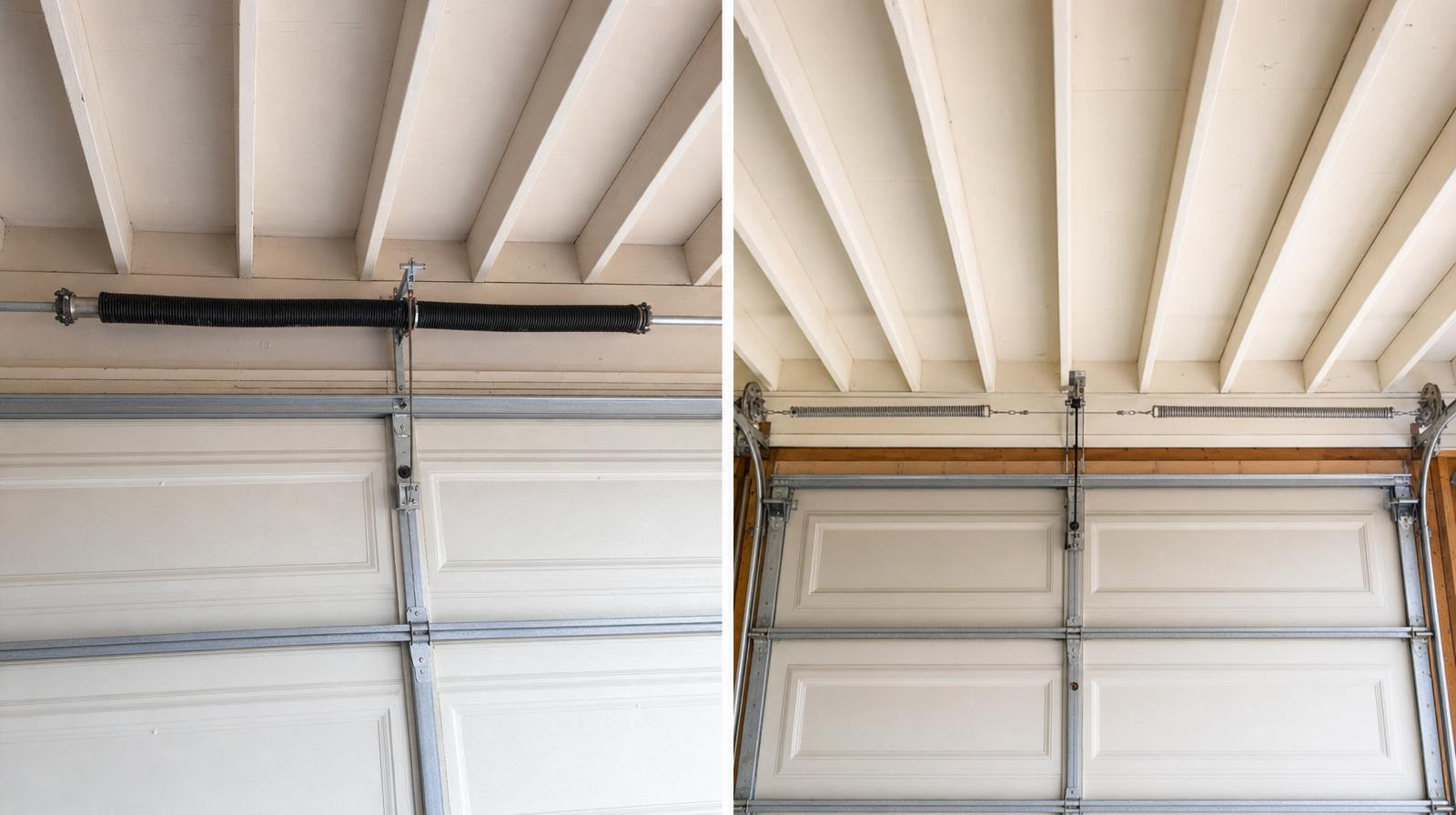
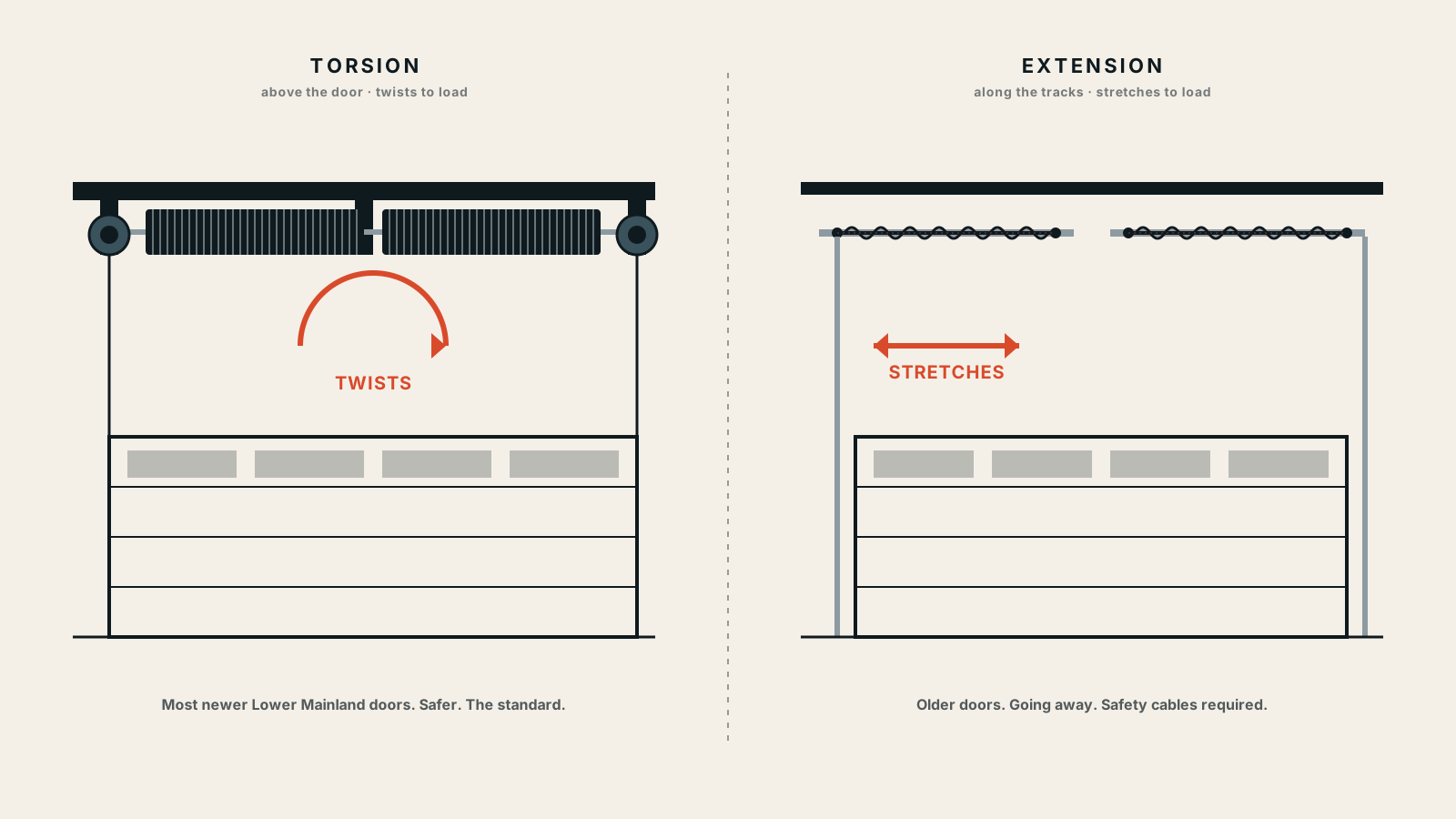
These first sectional doors used extension springs, two of them, one on each side of the door, attached to the back of the horizontal track. They worked, they were cheap, and they had a charming habit of releasing their stored energy across the garage if a cable let go. UL 325 wouldn't come along for another 35 years, so safety cables (which keep the spring from becoming a projectile) weren't yet required.
Most of these have been replaced. The ones we still see in service are usually in unrenovated 1950s ranchers in central Burnaby or Maillardville. They're a sentimental call — homeowner inherited the house, wants to keep it as-is. We swap to torsion and run a safety cable inside the extension spring for the holdouts.
The 1960s and 70s — Torsion springs become standard
Torsion springs — mounted on a horizontal shaft above the door, twisting rather than stretching — moved from commercial doors into residential during the 1960s. By 1975, most new sectional door installs in the Lower Mainland were torsion. They were quieter, more controlled, and they failed in a more predictable way (one big bang instead of two flying extension springs).
The 1970s Vancouver Special is the iconic house of this era — three or four bedrooms upstairs, in-law suite downstairs, single attached garage at grade. Hundreds of thousands of them across the Lower Mainland, mostly East Van, Renfrew-Collingwood, central Burnaby, central Surrey. Most have original torsion hardware. That's a 50-year-old install. The original springs are long gone — most are on their third or fourth set by now — but the brackets and shafts are often original.
The 1980s and 90s — Insulated doors and electric openers everywhere
The Liftmaster and Genie openers became standard install items in this era, electric chain-drive units mounted to ceiling joists. Insulated sectional doors (foam core between two steel skins) took over from single-skin steel as the default. The 1993 UL 325 update mandated the photo-eye sensors that every modern door has now.
This is the era when most of the houses we service today got their hardware. Coquitlam's Westwood Plateau, Surrey's Fleetwood and South Surrey, North Vancouver's Lynn Valley expansion, the upper Burnaby slopes. Builder-grade doors, builder-grade springs, originally rated for ten years and most of them well past that now.
The 2000s — Carriage-style returns (as a finish, not a function)
Around 2003 the carriage-door look came back as a finish on regular sectional doors. The big estate homes in West Van, the rebuilds in Shaughnessy and Point Grey, the new builds in Morgan Heights and Terra Nova — all started ordering doors that looked like 1920s swing doors from the front but operated like 2003 sectional doors. Wood-clad or wood-look composite over a standard steel sectional. Decorative hinges that don't actually hinge. Black iron handles that don't open anything.
The springs are the same as the cheaper doors. The only mechanical difference is the door weighs more, so the spring spec is heavier. A copper-clad triple-bay carriage door in West Vancouver might weigh 380 pounds. That needs serious hardware. We carry the gauge.
The 2010s — Olympic-era condo boom
I'll keep this short because Dale wrote a whole piece on it. Roughly 28,000 condo and townhouse units built between 2008 and 2012, almost all with minimum-spec doors, all hitting end of life now. The Olympic legacy in garage door form. Read his post if you live in a building from this era.
The 2020s — Laneway houses and the second garage
This is the era we're in now. City of Vancouver zoning changes since 2009 (and accelerated under multiple recent council cycles) have allowed laneway houses on most single-family lots. East Van, Kits, Mount Pleasant, and increasingly Kerrisdale and Dunbar have laneway homes — small 1- or 2-bedroom houses at the back of the lot, often built over a single-car garage.
The garage is structurally part of the laneway house. The door is usually 7- or 8-foot wide, single panel, modern sectional. The interesting thing from a service standpoint is that the laneway garage is often the bottom floor of someone's home — they live in the upstairs loft and the door cycles four or five times a day below them. Vibration. Noise. The acoustic spec matters.
For laneway homes we usually go with sealed-bearing torsion sets and high-cycle springs as a default, even on a residential price tier, because the noise complaint potential is real and the cycle count is higher than a typical detached single-family. Strata bylaws on laneway rentals are still evolving — that's a different mess.
The architectural lesson in one paragraph
From swing-out cedar in 1922 to sealed-bearing torsion in a 2024 laneway home, the door tells you exactly when the house was built and roughly what era of spring tech is behind it. If you know the architectural style, I can usually guess the spring spec before I open the truck. Heritage Shaughnessy carriage doors get gentle hardware. Vancouver Specials get standard. Olympic-era condos get 25,000-cycle high-cycle as the honest answer. Laneway homes get sealed bearings and quieter rollers. The salt is the only thing that doesn't care what year your house is from.
The honest bit
The reason this post exists is that I love this. Three generations on Lulu Island plus seventeen years in the trade means I've watched the architecture change in front of me. The houses my grandfather's friends lived in are mostly gone. The houses we built in their place are the houses I service now. The doors get prettier. The hardware gets cleverer. The salt stays the same.
Same family. Same number. If your door is from any of the eras above and it's making a noise you don't like — call before noon, we can usually fit you in same day.